What is an AI Agent? From Concepts to Domestic and International Corporate Cases
🧑💻 Summary
In this article, we first examine the concept of AI agents—AI that autonomously observes, judges, and acts to achieve specific goals—and how they differ from generative AI. We then introduce competition and cooperation trends among global Big Tech companies, such as OpenAI’s shift to an ‘agent super app’ and the establishment of the Agentic AI Foundation (AAIF), as well as the domestic strategies of Naver, Kakao, and Hancom. Finally, we look at AI agent use cases by industry, including healthcare, finance, and tourism.
With a single phrase like “Tell me the latest AI trends,” AI goes beyond searching for related news and summarizing key content; it now sends daily morning updates via email without further instruction. AI has evolved from a simple conversation partner into an entity that plans and performs tasks independently. This is the ‘AI Agent,’ which has emerged as a core keyword for the 2026 AI market.
So, how do AI agents differ from existing generative AI, and how are they being utilized in the market?
In this article, we will explore the concept of AI agents, their differences from generative AI, global and domestic corporate trends, and field cases by industry.
What is an AI Agent?
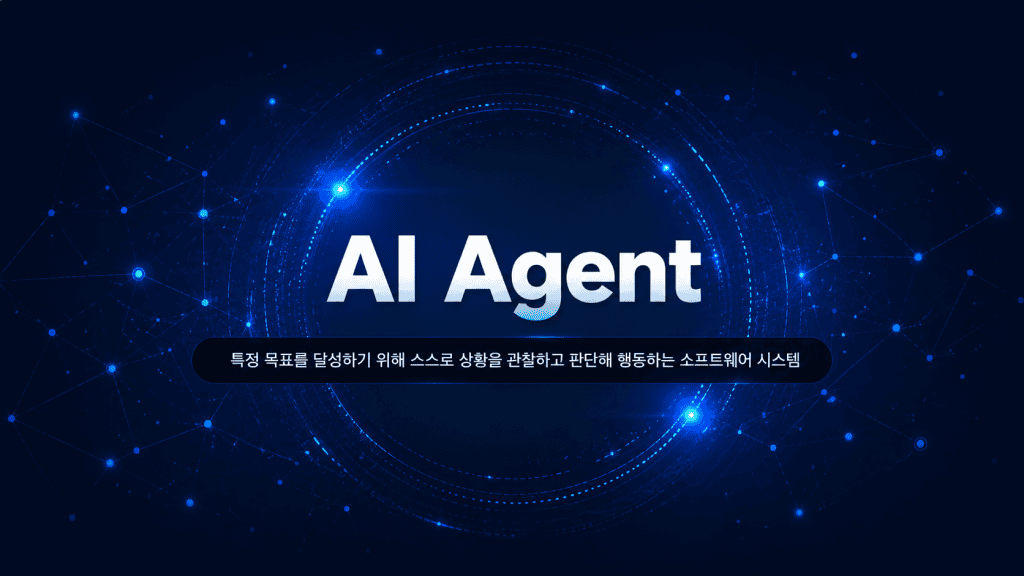
An AI agent (AI Agent) is a software system that observes, judges, and acts autonomously to achieve specific goals. Its core characteristic is the ability to perform tasks independently to reach a given objective without user intervention.
Differences Between AI Agent and Generative AI (Chatbot)
| Category | AI Agent | Generative AI (Chatbot) |
| Role | Autonomous Executive Assistant | Conversational Assistant |
| Primary Purpose | Task automation to achieve specific goals | Understanding user intent and generating content |
| Operational Method | Autonomous execution via Observe → Judge → Act structure | Passive operation based on user instructions |
| Core Value | Autonomy and Scalability | Immediacy and Efficiency |
The biggest difference between generative AI (chatbots) and AI agents is autonomous execution.
When asking a generative AI (chatbot) to “summarize the latest AI trends and share them with the team,” you must provide direct instructions at every step, such as “search for news,” “summarize the key points,” and “format it as an email.” However, an AI agent judges and executes the entire process—searching, organizing, and sending—on its own with just a single request.
In other words, an AI agent reads the context of a user’s request, combines necessary tools and resources for execution, and autonomously performs everything from reviewing to improving the results.
AI Agent Market Outlook
The AI agent market is growing rapidly. According to the global market research firm MarketsandMarkets, the AI agent market size is expected to grow from $7.84 billion in 2025 to $52.62 billion by 2030, with a compound annual growth rate (CAGR) of 46.3%.
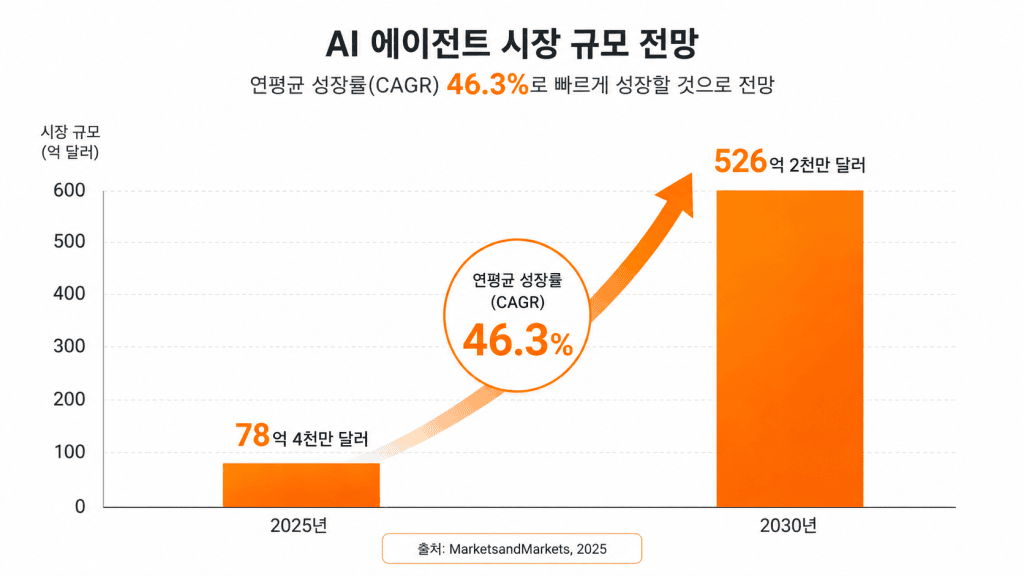
While 2025 was the year of the emergence and spread of AI agents, 2026 is being highlighted as a turning point where AI agents move beyond the experimental stage to create substantial value across businesses. According to the ‘2026 Agent Trends Report’ published by Google Cloud, AI agents are projected to become the central axis that changes the way entire industries work, moving beyond simple convenience.
Two Trends in the Global Big Tech AI Agent Market
AI Agent Competition Intensifies, ChatGPT Announces Transition to ‘Agent Super App’
Global Big Tech companies that have led the generative AI market are accelerating their competition in AI agents.
Notably, OpenAI is pursuing a service reorganization to evolve ChatGPT from a simple conversational service into an ‘Agent Super App’ that combines coding tools with autonomous agents.
With a vision to focus capabilities on building ‘personal agents’ that handle actual tasks on behalf of users, the company is showing a strong commitment to an agent-centric transition, even declaring internally that “chat is dead.”
Declaration of Cooperation to Establish Common Standards for AI Agents
While competition heats up, industry-wide cooperation is also continuing. Major Big Tech companies, including OpenAI, Anthropic, Google, MS, Amazon, and IBM, have established the ‘Agentic AI Foundation (AAIF)’ to develop common standards for AI agents.
The current AI agent market is often compared to the early 1990s before internet standards (HTTP) were established; issues such as incompatibility between AI agents built by different companies and varying security standards persist. Consequently, major Big Tech companies are moving toward establishing common standards together to ensure AI agents can move beyond prototypes and take root in actual industrial fields.
How are Domestic Companies Targeting the AI Agent Market?
Domestic companies are as active as overseas firms in strengthening their AI agent capabilities. According to the ‘2026 Domestic Enterprise IT Investment Outlook’ report by Samsung SDS, more than 7 out of 10 domestic companies plan to significantly expand their investment in AI agents this year. Particularly noteworthy are Naver, Kakao, and Hancom, which are deploying differentiated strategies based on their respective core assets.
From Search to Execution, Naver’s ‘Agent N’
– Bum-jun Kim, COO (Chief Operating Officer) –
Naver’s ‘Agent N’ is a personalized behavioral AI agent tailored to individual users by integrating data from various services such as search, shopping, finance, and cafes. Its key differentiator is presenting different results based on the user’s context even for the same keyword. Starting with the ‘AI Shopping Agent’ in the shopping sector where user impact is high, Naver is gradually expanding AI agents into various areas like search and brokerage.
Human-Centric AI, Kakao’s ‘Kanana in KakaoTalk’
– Shina Chung, Chair of the CA Council –
Kakao’s ‘Kanana in KakaoTalk’ is an AI agent service where the AI, having understood the context of the user’s conversation, suggests necessary actions such as venue reservations or product purchases even before the user requests them. As Kakao has set ‘human-centric AI’ as its core growth pillar this year, it is leveraging its strength in understanding the daily context of 50 million users to create a new Kakao-style AI agent ecosystem.
Evolution of 36 Years of Document Technology, Hancom’s ‘Hancom Assistant’
– Yeon-soo Kim, CEO –
Hancom’s ‘Hancom Assistant’ is an AI agent service that automatically handles document creation, editing, and analysis with a single natural language command, such as “Draft a report” or “Summarize this document.” Beyond simply introducing a tool, Hancom is sequentially integrating micro-agent functions specialized for each business process based on 36 years of accumulated document technology, allowing customers to experience the effects of AI transformation (AX) directly in actual work environments.
AI Agent Use Cases by Industry
As domestic companies expand the AI agent ecosystem, specialized AI agents optimized for specific industries or tasks are also rapidly appearing. The global market research firm Gartner predicted that by 2026, 40% of enterprise applications will feature task-specific AI agents.
So, how are AI agents being used in actual fields? Let’s look at cases from the medical, financial, and tourism industries.
Medical: Seoul National University Hospital ‘SNUH.AI’
Seoul National University Hospital established ‘SNUH.AI,’ an AI agent platform that brings together various medical AIs operated separately within the hospital and connects them to the hospital system. The AI automatically identifies a patient’s underlying conditions and test results before surgery to fill out checklists or automatically generates discharge documents based on inpatient records. As a result, medical staff can reduce time spent on paperwork and focus more on patient care.
Finance: Toss Bank AI Financial Consultation
Toss Bank introduced a financial consultation service where AI provides guidance on complex financial products. It explains difficult financial terms and procedures in simple language and recommends optimal products suited to the customer’s situation. This has enabled people who found financial information unfamiliar and distant to easily obtain the information they need with the help of AI.
Tourism: Creatrip
Creatrip, a travel platform for foreign tourists, covers the entire travel process from planning to local transportation using AI. The ‘Travel Itinerary AI Agent’ identifies the traveler’s preferences and situation through conversation and autonomously performs itinerary search, recommendation, editing, and route optimization. Foreign tourists who were once overwhelmed by language and information barriers can now start their trips to Korea much more easily.
2026, The Future of Work Changed by AI Agents
2026 is the turning point for the expansion of AI agents.
The trend of transforming AI from a simple auxiliary tool into an entity that handles actual work is gaining momentum across domestic and international companies, as well as in industrial fields such as healthcare, finance, and tourism.
As the scope of AI agent utilization expands, the importance of operating systems (Agentic OS) and AI security to safely coordinate and manage them is also growing. In line with this trend, Hancom has declared its transformation into a ‘Sovereign Agentic OS’ company.
A company’s competitiveness depends not just on adopting generative AI, but on how effectively it operates and manages AI agents specialized for each industry and task. Hancom’s ‘Sovereign Agentic OS’ is an integrated AI agent operating system that connects and controls internal organizational data, external AI models, and business systems within a single secure environment, enabling safe operation and management of AI agents while protecting data sovereignty.
If your company is preparing for the era of AI agents, please take note of Hancom’s ‘Sovereign Agentic OS.’
Key Summary Q&A
Q. What is the biggest difference between an AI agent and generative AI (chatbot)?
The biggest difference between generative AI (chatbots) and AI agents is autonomous execution.
While generative AI (chatbots) require direct instructions from the user at every step for a task to be completed, an AI agent observes the situation, makes judgments, and completes execution on its own with just a single request. The core difference is that once the user presents a goal, the AI autonomously performs planning, execution, and review.
Q. Why did global Big Tech companies establish the ‘Agentic AI Foundation (AAIF)’?
To resolve issues of incompatibility and differing security standards between AI agents built independently by each company.
The current AI agent market is in a situation similar to the internet in the early 1990s when there was no HTTP standard; establishing common standards is a prerequisite for AI agents to take root in actual industrial fields. Accordingly, major Big Tech companies such as OpenAI, Anthropic, Google, MS, Amazon, and IBM have established the Agentic AI Foundation (AAIF) and are working to establish common standards for AI agents.
Q. What are some examples of AI agent services from major domestic companies?
Domestic companies are moving to preoccupy the market by pursuing differentiated AI agent strategies based on their core assets.
Naver launched ‘Agent N,’ a behavioral agent that understands user context by integrating data from various services like search, shopping, and finance. Kakao released ‘Kanana in KakaoTalk,’ which suggests actions first based on the daily context of 50 million users. Hancom provides ‘Hancom Assistant’ as an AI agent service that handles document creation, editing, and analysis with a single natural language command, based on 36 years of accumulated document technology.
📄 References
- MarketsandMarkets, “AI Agents Market Report 2025-2030”
- Google Cloud, “AI Agent Trends 2026”
- Samsung SDS Insight Report, “2026 IT Investment Outlook,” 2026
- Donga Business Review (DBR), “Naver Unveils ‘Agent N’: Changing Identity from Search to Execution,” 2025
- Tech M, “Kakao CEO Shina Chung: ‘The Direction is Agentic AI… Naturally Connecting Daily Life with AI’,” 2025
- Electronic Times, “Hancom Assistant Becomes First in Korea to Obtain ‘AX Usability Certification’,” 2026
- Gartner, “Gartner Predicts 40% of Enterprise Apps Will Feature Task-Specific AI Agents by 2026,” 2025
👀 Recommended Content
- [Hancom Tech Blog] “2026 AI Trends: Agentic AI Evolving from ‘Tool’ to ‘Work Subject'”
- [Hancom Blog] “HANCOM: THE SHIFT Into Agentic OS Field Sketch”