How to Find Prior Research with AI Paper Search: Asking Tlooto in Hangul and Verifying Sources

When writing a paper or research proposal, we often start by looking at prior research on similar topics. This is because knowing what other researchers have uncovered and what tasks they have left behind helps determine the content and direction of your own research.
However, even after searching for relevant papers, it is not easy to decide which materials to read first. There are often too many search results, and titles may be similar while the research subjects or contents differ significantly. In such cases, using an AI paper search allows you to find relevant materials and compare research subjects, methods, and key results. This reduces the burden of organizing the contents of each paper separately and allows you to review the materials necessary for your research first.
Tlooto AI is an academic research support service that helps with paper searches and prior research analysis. By using Han-Addons, you can find academic materials and web information through Tlooto while writing Hangul documents and even verify the sources of the answers. Reviewed answers can be moved directly into the Hangul document you are working on, reducing the task of re-typing content after finding materials and allowing you to quickly continue writing your literature review.
So, how can you find the papers you need for your research with Tlooto? Using graduate school theses and public policy research as examples, let’s look at the process from creating search questions to selecting papers to read and organizing the evidence for your research.
Organizing What You Want to Find into Questions
Before searching for papers, try to organize what information you want to know. If you enter a broad topic like ‘youth housing,’ you may get materials dealing with different issues ranging from housing costs to employment and health. Writing down the research subject and the phenomenon of interest specifically makes it easier to filter out the necessary papers from the search results.
For example, if you are a graduate student researching youth housing, you might ask a question like this:
“Find research on the relationship between housing cost burden and migration intention among single-person youth households in the Seoul metropolitan area.”
A policy research manager reviewing youth housing support projects would need a different question for the same topic.
“Find research evaluating the effectiveness of youth housing support projects. Also, let me know what comparison groups and evaluation indicators were used.”
The first question asks about the relationship between housing cost burden and migration intention. The second question focuses on the method of evaluating policy effectiveness. Even with the same topic, the materials you need to find change depending on what you want to know.
If you are unsure how to write your question, try filling out the items below first.
| Content to Include in the Question | Questions to Ask Yourself | Example of Youth Housing Research |
| Research Subject | Who is the target of the study? | Single-person youth households |
| Phenomenon of Interest | What issue are you interested in? | Housing cost burden |
| Information Sought | What relationship or difference do you want to confirm? | Differences in migration intention according to housing cost burden |
| Region and Period | Which region and period will you look at? | Seoul metropolitan area, research published in the last 5 years |
You don’t need to finalize all items from the beginning. First, put the decided content into a question, and then adjust the scope while looking at the search results. The above questions are examples to explain the input method and do not present actual search results.
Asking Tlooto and Adjusting Search Results
Once you have organized your question, try running Tlooto through Han-Addons in Hangul and entering it. Tlooto searches academic materials and web information to provide answers and relevant sources.

Feature introduction screen on Tlooto’s official website
You might not get all the materials you want from the start. If there are too many search results, try narrowing the scope by specifying the region, publication year, or research field.
“Find papers published in the last 5 years focusing on research targeting single-person youth households in the Seoul metropolitan area.”
Conversely, if almost no relevant papers appear, it’s time to change your search terms. Check if there are studies that express the same concept with different terms and try using English search terms as well. You can also try broadening the region or publication year conditions.
During this process, be careful that terms may be similar but have different meanings. For example, ‘housing cost burden’ and ‘housing instability’ are related but are different concepts. If you read papers found with both terms together, you must also check how each study defined the concepts.
Once a certain amount of relevant material is gathered, ask to organize the differences between the papers.
“Organize the found papers according to the survey subjects, definition of housing cost burden, research methods, and key results. Also, provide the source for each paper.”
Setting items to compare makes it easier to judge which paper to read first. Looking at the research subjects, methods, and key results organized by Tlooto reduces the burden of organizing the same items for each paper separately and allows you to focus on reviewing the similarities and differences between studies. However, rather than selecting materials based solely on Tlooto’s summary, a process of opening the linked sources to check the actual content is necessary.
Reviewing Sources and Choosing Materials to Read
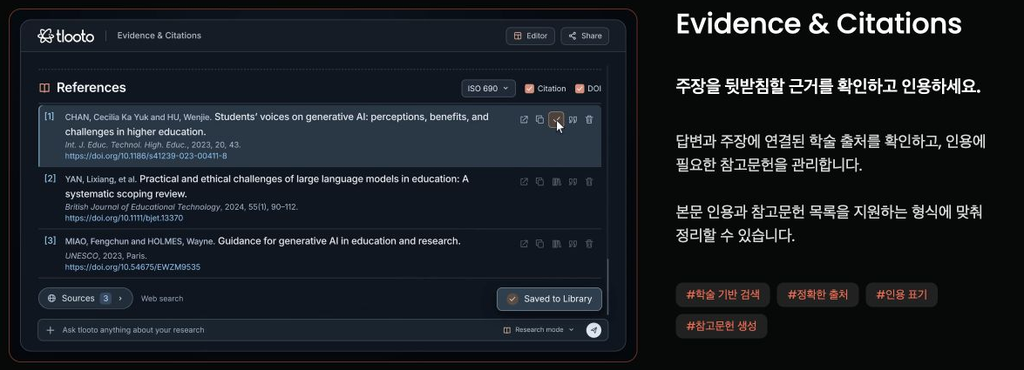
Once you have opened the materials linked to the answer, first check the type of material. This is because the purpose of writing and the information contained may differ between journal papers, research institute reports, government statistics, and general web documents.
For example, if you want to find out the effectiveness of a youth housing support project, you can check the target and content of support on the project information page. To judge the actual effect, you need research that analyzes changes before and after project participation or comparison groups.
Look for the following content in each material:
| Material Type | Content to Check First |
| Journal Paper | Title, author, publication year, journal, abstract |
| Research Institute Report | Issuing organization, research purpose, survey subject and method |
| Govt. Statistics and Guides | Definition of statistics, survey timing, subject and scope |
| General Web Document | Authoring entity, date of creation, raw data supporting the claim |
Feature introduction screen on Tlooto’s official website
After checking the type of material, read the title and abstract to judge how relevant it is to your question. Start by choosing papers whose research subjects and core concepts match as candidates for reading. Even if ‘youth housing’ is in the title, if it does not deal with the variables or discussions you want to examine, you should lower its priority.
At this time, do not judge the value of the material based solely on the publication year. Recent papers are helpful for understanding current discussions, but it is also necessary to look at research that first presented core concepts or theories.
By selecting candidates to read in this way and then checking the research methods and results in the original text, you can save time by not having to read all the many materials.
Checking Research Methods and Results in the Original Text
Once you have chosen the papers to read, compare the original text with the content organized by Tlooto. Since you can find the relevant material through the sources linked to the answer, you can reduce the effort of re-searching for the paper that served as the basis for the summary. However, even if there are sources, AI may misinterpret research results or omit important conditions, so a human review stage is essential.
First, check who the study targeted and what was investigated. See if the age criteria for youth or the definition of a single-person household is the same as your research, and whether they surveyed ‘migration intention’ or analyzed actual migration records. Even papers using the same words may have different measurement methods.
When reading research results, you must distinguish between relationship and cause. You should not conclude that housing cost burden increases migration intention based solely on the result that there is a relationship between the two. You must check what analysis the researcher performed and what conclusions they reached.
For policy research, the timing of data collection is also important. Even in a recently published report, the data used for analysis may be survey results from several years ago. Recording the publication year of the paper or report and the actual survey year separately helps in judging whether it can be referenced for current policy.
Try reading research that presents results different from your expectations as well. By looking at the reasons why there was no effect or why results came out in the opposite direction, you can also examine whether conclusions change depending on the subject or survey method.
If you were unable to access the original text, record the scope of what you read separately. For materials where you only read the abstract, leave a note saying ‘checked abstract only,’ and it is better to check the detailed content to be cited in the body after securing the full text. Check if it is available at institutional libraries, publishers, or sites providing raw data.
Organizing Evidence and Limitations of Read Papers in a Table
Recording important content every time you read a paper makes it easier to compare multiple studies. It can also reduce the time spent re-searching for sources while writing sentences later. Try using the comparison of papers previously organized by Tlooto as a draft for your evidence table. Organize bibliographic information such as author and title, research subjects, and methods, and supplement with content to be utilized and limitations while reading the original text.
| Record Item | Content to Write Down |
| Source | Author, publication year, title, link to original text |
| Research Subject and Data | Region, group, sample size, survey timing |
| Core Concepts and Methods | Definition and measurement of variables, analysis method |
| Key Results | Relationships or differences identified by the researcher |
| Location of Evidence | Page, section, or table number containing content to cite or reference |
| Use Case | Parts to reference among the theory, method, or result interpretation of my research |
| Limitations | Limitations of the sample, measurement method, or scope of applying results |
Leave a source not only when directly quoting sentences but also when referencing ideas or research methods. If you recorded a summary written by AI, it is better to distinguish it from the content confirmed in the original text.
Materials that have been recorded can be categorized according to the purpose of use.
- Core Evidence: Materials directly related to my research question to be used in major discussions
- Background Reference: Materials helpful for understanding concepts, theories, or research methods
- Additional Verification or Exclusion: Materials that require further original text verification or have low relevance to my research
Suppose my research deals with migration intention, but a certain paper analyzed actual move-in records. Rather than excluding this paper immediately, you can examine whether it can be used as background material explaining the difference between migration intention and actual behavior.
When classifying, also write down the reason briefly. Recording notes like ‘different target region,’ ‘reference when comparing variable definitions,’ or ‘review after securing full text’ will prevent you from having to repeat the same judgment later.
Refining My Research Question Based on Prior Research
As you fill in the evidence table, you will see parts where results differ by study or have not yet been sufficiently explained. Even if you initially looked for the ‘relationship between housing cost burden and migration intention,’ after reading the papers, you may become interested in the question, ‘Does the result change depending on the method of measuring housing cost burden?’
If the previous questions were for finding relevant materials, it is now time to refine what to deal with in your research based on what you have read. Present the differences in the compared studies or parts that have not yet been sufficiently explained to Tlooto, and ask it to suggest research questions based on this.

Feature introduction screen on Tlooto’s official website
“The way housing cost burden is measured differs for each paper I read. Some used the housing cost-to-income ratio, and some surveyed subjectively perceived burden. Suggest a research question that can compare this difference.”
Compare the suggested questions with existing research. Even if the expression looks new, it may be a problem already dealt with by another researcher. You should also look at whether you can obtain the necessary data, whether core concepts can be measured, and whether the research can be completed within the set period.
For public policy research, also examine how the answer to the question helps in actual policy judgment. The necessary data and analysis will change depending on whether you are trying to confirm the effectiveness of a project or adjust the target of support.
If you have modified the research question, search for papers again with the changed question and add materials to the evidence table. By repeating the process of searching, reading, and refining questions, you can specify the scope and direction of your research.
Frequently Asked Questions When Using AI Paper Search
Can I use Tlooto’s answers directly in my paper?
It is best to use the answers for choosing materials to read and organizing points of argument. Content to be reflected in the paper should be organized according to your research purpose after checking the original text, and the relevant material must be cited.
Can all searched papers be read for free?
Even if there is a link to the original text, payment or an institutional subscription may be required to read the full text. Check your affiliated institution’s library subscription and whether there are any open original texts.
Can it also be used for public policy research?
It can be used to find public papers, reports, and statistics and to organize relevant evidence. Policy effectiveness or project feasibility must be judged by the researcher by reviewing the survey methods and application scope of the data. Before entering undisclosed institutional data or personal information, you must check institutional regulations and service policies.
Can I set a question suggested by AI as my research topic immediately?
First, look at what differences there are from existing research. It is better to decide on a topic after examining whether the necessary data and research methods can be secured.
Starting Prior Research Search in Hangul Documents
Write down what you want to find out in the research proposal you are currently writing in one sentence. Run Tlooto from Han-Addons to ask questions by adding research subjects and scope, and organize the main contents and differences of relevant papers. After confirming the evidence to be utilized from the linked sources, continue writing by reflecting the necessary answers in your research proposal with ‘Transfer to Hangul.’
All features of Tlooto can be found on the Tlooto official website.
Please refer to the Han-Addons official guide for how to use it in Hangul and the supported environment.