From Finding Supporting Papers for Paragraphs to Citation Methods: How to Use tlooto

When writing a thesis or research report, you need sources or evidence to prove your claims or sentences. Even if you have referenced papers, it can be confusing to know which source to attach to which sentence. This is because a paper with a similar topic does not necessarily support all the claims you have written.
In such cases, you must first divide the claims that require evidence, find the appropriate papers for each claim, and write the sources according to the citation format required by the submission destination.
tlooto AI, an academic research support service available in Hangul, helps you find the necessary academic sources for your written paragraphs. With Smart Referencing, you can find sources related to the paragraph and transfer the reviewed answers to a Hangul document. Since you can find evidence based on already written paragraphs and reflect content including citation marks, it is convenient to continue searching for sources and revising manuscripts.
Using a paragraph currently being written as an example, we will look at the process from finding evidence to selecting citation formats and checking references.
Explore tlooto’s research writing support features in HanAddons
Divide the claims that require evidence first
Before finding supporting papers for a paragraph, look at what content requires a source. Sources must be disclosed for content taken from other materials, such as results of existing research, conceptual definitions, or statistical figures. If one sentence contains multiple claims, the materials supporting each claim may need to be specified separately.
For example, suppose you wrote the sentence, “The housing cost burden of young people increases their intention to migrate, and housing support policies alleviate this.” This sentence contains both the claim that housing cost burden affects migration intention and the claim that housing support policies have an alleviating effect. Since research dealing only with the first relationship cannot explain the policy effect, you must divide the two claims and search for materials.
After dividing the claims, organize what kind of materials are needed. Even within the same paragraph, the content to be verified may differ between a sentence explaining a concept and a sentence explaining a policy effect.
| Content in the sentence | Materials to look for | Content requiring original text verification |
| Conceptual definition | Original material defining the concept | Whether it was explained with the same meaning and scope as the original |
| Existing research results | Papers containing research methods and results | Whether the research subject, timing, and analysis conditions match |
| Statistical figures | Original data from the institution that published the statistics | Whether the survey year, unit, and calculation criteria are accurate |
| Policy effect | Research analyzing the effects of the policy | Whether simple differences between groups were not explained as policy effects |
Your own research purpose or plan should be written separately from the conclusions of other researchers. This is because the plan to conduct research itself is different from the evidence judged necessary for that research. When entering a paragraph into the AI, organize it focusing on the claims to be reviewed and check if it is okay to include unpublished research content or personal information.
Find related papers with Smart Referencing and check the original text
Once you have organized which claims need evidence, you can utilize tlooto’s Smart Referencing. Smart Referencing is a feature that finds academic sources related to the entered paragraph and adds citations. Since you can start searching for evidence with the paragraph you have written, you can reduce the effort of searching multiple times by changing the sentence content into search terms.
Assuming you are looking for materials for the claim written as an example, try requesting as follows.
‘Find academic materials to support the following paragraph. Distinguish between research on the relationship between housing cost burden and migration intention and research on the effects of housing support policies, and explain which material supports which claim.’
Once you receive an answer, you must check the source directly. This is because even if the titles are similar, the research subjects or definitions of variables may be different. To cite a study targeting all households in a sentence explaining young people, you would need to check if the results can also be applied to young people.
Refining sentences according to the scope supported by the original text
While checking materials, you may need to modify the document you are currently writing. If only the correlation between two variables was confirmed in the original text, you should not conclude cause and effect, such as “Housing cost burden increases migration intention.” In this case, the expression should be modified to match the research results, such as “A correlation was found between housing cost burden and migration intention.”
In this way, for academic sentences, you should not only smooth out the expressions but also check if the results of a specific group have been applied to the whole. Claims with insufficient evidence should be narrowed in scope or put on hold. If there is a study that presents opposite results, also review how the research subjects and conditions differ.
Select a citation format that meets the submission criteria
After confirming that the claims and evidence match, it is time to decide in what format to display the sources. In tlooto, you can choose a citation format among APA, MLA, and ISO 690. If you decide on the format before transferring the answer to Hangul, you can reflect the content including the corresponding citation marks in the document. Since you can organize citations based on the selected format, you can reduce the burden of writing marks one by one from the beginning.
The citation format must be selected according to the regulations of the place of submission. Check the graduate school thesis guidelines, journal submission regulations, or report writing standards first. Even with the same APA format, the required edition or detailed rules may differ, so you should not judge by the format name alone.
After selecting the format, cross-check bibliographic information such as author, publication year, and paper title with the original material. Depending on the type of material, required information such as journal name, volume/issue, page, and DOI may vary. You must also directly check if there are any omissions or errors in the displayed information.
When writing sources, you must also distinguish between direct citations and cases where content is summarized. If you used the expressions of the original text exactly, enter the citation mark and location information such as pages according to the submission regulations. Regardless of the format, if you used the ideas or results of another researcher, you must disclose the source.
Transfer the confirmed answers to a Hangul document
After reviewing the content and citation marks, try transferring the necessary content to the Hangul document you are writing. You can drag and send only the desired part of the tlooto answer, or it is possible to move the entire answer. By selecting and reflecting only the explanations necessary for the paragraph you are writing, you can reduce the effort of reorganizing unnecessary content after moving the entire answer.
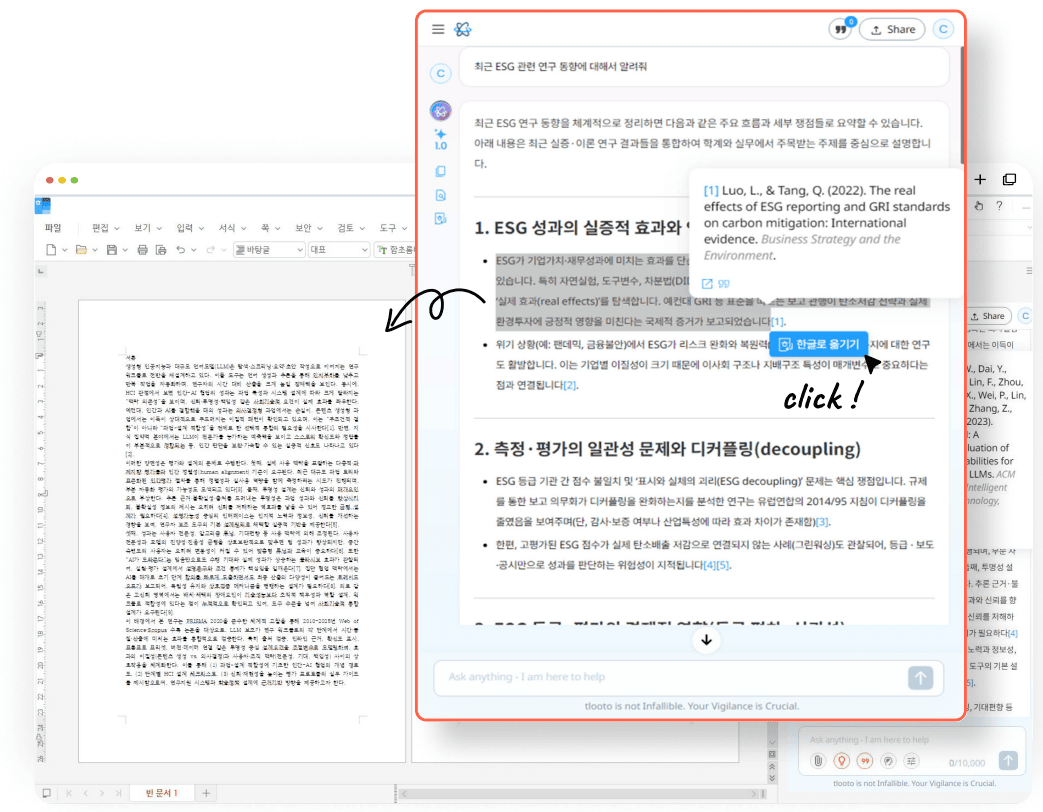
When selecting and moving only a part, be careful not to omit sentences explaining the research subject or application conditions. Even after moving the AI answer to Hangul, read and review whether the sentences and sources are properly connected, and distinguish between notes for review and content to be used in the main text.
Answers containing formulas also need verification. If you used the Hangul formula input function, cross-check if the symbols, subscripts, denominators, and units are the same as the original formula. You must also check if the meaning of the formula matches the surrounding explanation before it can be used in the main text.
By utilizing Hangul thesis writing AI, you can reflect content in the document you are writing while checking materials. Check HanAddons for the Hangul environment and usage methods where tlooto can be used.
Check how to use tlooto in HanAddons
Cross-check in-text citations and references one last time
Once you have reflected the content in the document, you must also organize the references. Sources of answers sent to the Hangul document are automatically saved in tlooto and can be used when looking up materials used during writing again. Even when you need to re-verify evidence while revising the manuscript, you can refer to the saved sources, reducing the effort of searching for previously used materials from scratch.
However, the saved source list is not used as the final reference list as is. This is because there is content that was moved for review but deleted from the main text, and there are materials that were directly found and added. Hangul reference management must be completed up to the stage of cross-checking the list based on the citations remaining in the final manuscript.
Before submission, please check the following.
- Check if the claims in the main text have the same meaning as the results of the cited paper.
- Cross-check if the author, publication year, title, and original text link point to the same material.
- Check if the directly cited expressions and location information such as pages are accurate.
- If the same source is cited multiple times, check if the bibliographic information is written consistently.
- Check if the materials cited in the main text are not missing from the references, and organize unused materials according to submission regulations.
- If the submission destination requires disclosure of AI usage, record it according to the corresponding regulations.
It is good to note the reviewed content along with the location of the used paragraph and the original text. For example, writing “Housing cost definition sentence in theoretical background – Check conceptual definition section of original text” makes it easy to find what evidence was verified when revising the manuscript.
In the process of checking, you may feel that the materials you have read are insufficient as evidence. If you need to find more related papers, refer to How to find previous research with paper search AI. You can explore the process from specifying research questions to selecting materials to read.
FAQ on Finding Supporting Papers for Paragraphs and Citation Methods
Can I just paste the sources suggested by Smart Referencing as they are?
You must first check if the original text supports the current sentence. If the research subjects or conditions are different, you should adjust the scope of the sentence or find other evidence.
Can I move only the necessary sentences from the answer to Hangul?
Yes. You can drag and select the necessary parts and then send them. Moving the entire answer is also supported. When selecting only a part, check the source and application conditions of the corresponding sentence together.
Which citation format should I choose?
tlooto supports APA, MLA, and ISO 690 formats. You must select a format that meets the latest guidelines of the submission destination and then check the detailed notation and bibliographic information.
Is reference organization finished once the sources are saved?
You must cross-check the saved list and the final main text again. Since references change depending on the content added or deleted in the main text, look for missing materials or unused materials.
Can I cite the original paper after reading the AI’s explanation?
If you are writing based on the results of the original paper, you must directly check that original text. You should not cite it as if you have checked the original text after only reading the AI’s explanation. Check the submission destination regulations to see if you need to separately indicate the fact of AI usage.
Start by checking just one paragraph you are writing
Thesis citation starts with finding evidence that fits the claim. Mark the claims that need sources in the paragraph you are writing and find related papers with tlooto. After checking the original text, refine the sentences and citation marks, and reflect the necessary answers with ‘Transfer to Hangul.’ Start from a paragraph you have already written and continue from finding evidence to organizing sources.
tlooto’s full features and terms of use can be found on the tlooto website.
Please refer to the HanAddons guide for the environment and connection methods available in Hangul.
Check tlooto usage environment in HanAddons