Why Unstructured Data Parsing Is Difficult and How to Structure It with AI Document Parsing
You feed documents into your RAG system, only to find that tables break apart and answers come out wrong, or text is extracted but the connection to its corresponding field is lost. If you’ve worked on digitizing documents from public institutions or financial organizations, this scenario is all too familiar. The root cause lies in the nature of the data itself. Unstructured data—which makes up the majority of enterprise information—lacks a predefined structure, making it difficult to analyze in its raw form. In this article, we examine why unstructured data parsing is challenging and how AI document parsing enables structuring.
What Is Unstructured Data?
Unstructured data refers to information without a predefined structure such as rows and columns (schema). Examples include documents, emails, images, and videos—formats that vary in shape and are difficult to analyze directly using traditional data tools.
What Does Unstructured Data Mean, and How Does It Differ from Structured Data?
Unstructured data is information without a predefined data model or schema, in contrast to structured data, which is organized into rows and columns. The key difference lies in when structure is applied.
According to IBM technical documentation comparing structured and unstructured data, structured data has a fixed schema, is stored in relational databases (RDBMS) as rows and columns, and is queried using SQL. Unstructured data, on the other hand, has no fixed schema and exists in complex formats such as audio or web pages, making it difficult to fit into traditional databases.
| Criteria | Structured Data | Unstructured Data |
| Presence of Structure | Fixed schema (rows and columns) | No predefined structure |
| Storage Location | Relational database (RDBMS) | Data lake, etc. (raw form) |
| Query Method | Queried via SQL | Requires separate processing and analysis |
| Schema Application Timing | Schema-on-write (structured before storage) | Schema-on-read (applied at time of use) |
What Types of Unstructured Data Exist?
Unstructured data exists in a wide variety of forms, from text-based data such as documents and emails to images, audio, and video.
- Non-text-based: Images (JPEG, GIF, PNG), multimedia, video, mobile activity and IoT sensor data
- Text-based: Email, Word documents, PDFs, blog and social media posts, call transcripts and message text
Among these, the most challenging to handle in enterprise settings are text-based documents such as reports, contracts, and official correspondence that mix tables and hierarchical structures—representing the highest level of parsing difficulty.

Why Unstructured Data Parsing Is Difficult
Because unstructured data lacks a predefined structure, simply reading text in sequence damages table and structural information. This corrupted data then flows through the retrieval and generation stages of RAG, degrading overall quality.
Parsing Challenges Arising from the Absence of Structure
Unstructured data is difficult to analyze directly with traditional data processing tools because it lacks a predefined data model. Structure must be newly applied at the point of use, and restoring that structure is itself a complex task.
A representative challenge is tables within documents. The RobusTabNet study on table recognition identifies the stable detection of table location and structure across varying formats as a core challenge. The Multi-Cell Decoder study, which addresses both table structure and character recognition, also views the automatic recognition of table structure and text as a problem that remains difficult to solve. Even tables that appear simple to humans require dedicated research for machines to accurately interpret their structure.
Cases Where Simple OCR and Text Extraction Damage Unstructured Data
Simple text extraction methods ignore document structure and read characters in sequence, causing information to become scrambled in tables or multi-column layouts.
The OHRBench study, which evaluates the impact of OCR (Optical Character Recognition) on RAG, defines two types of OCR noise: semantic noise, where characters are misread, and formatting noise, where structural representations such as tables and layouts are distorted. The core finding of the study is that even when characters are read correctly, remaining formatting errors degrade RAG quality.
Even the best-performing pipeline in the evaluation, OCR (MinerU), showed a 2.93-point drop in answer accuracy when using OCR-extracted text compared to answering from error-free source documents. Errors introduced during OCR conversion directly transferred to answer quality. When isolating formatting noise alone, performance dropped by up to approximately 16.8% in retrieval and up to approximately 19.4% in generation for certain queries and models.

Why Extracting Text or Table Data from HWP Files Is Difficult
HWP files are stored in a binary format that cannot be read directly by humans, and extracting content is difficult without dedicated software. As a result, HWP documents accumulated in public institutions and financial organizations face challenges from the very start of digitization.
The degree of difficulty becomes clear when examining the internal structure of the format. According to Hancom Tech’s technical article explaining the HWP format structure, HWP documents are divided into multiple streams such as DocInfo and BodyText, with each data unit stored as a record containing type, size, and content, followed by compression. This is why simple character extraction methods cannot restore such a multi-layered structure.
👉 Read more on the Hancom Tech blog
Why Are Tables (Merged Cells and Multi-Level Headers) Not Extracted Accurately?
In tables, the structure itself carries meaning through the relationships between cells. Restoring that structure accurately is not straightforward, especially for merged cells or tables with unclear boundaries.
The core difficulty lies in ‘invisible structure.’ The Multi-Cell Decoder study views the joint recognition of table structure and text as a key challenge in knowledge information processing, treating vertically and horizontally merged cells and tables with invisible borders as difficult recognition targets. The RobusTabNet study also identifies tables with large empty spaces or distorted shapes as core challenges, proposing a method that divides tables into cell grids and then reconstructs merged cells.
The recent TABLET study on table recognition also proposed a model that restores complex table structures by splitting rows and columns and then re-merging cells. Accurately reading tables with merged cells and multi-level headers remains a challenge that is still being addressed.
Why Unstructured Data Processing Quality Affects the Entire RAG Pipeline
When document structure is damaged and only text is extracted, incorrect information is retrieved at the search stage, ultimately leading to hallucinations where the LLM generates inaccurate answers.
Typically, the RAG process follows the flow: document extraction → parsing → chunking → embedding → vector DB storage → retrieval → LLM answer generation.
Inaccurate extraction cascades through subsequent stages. The HiChunk study on hierarchical chunking also points out the lack of evaluation tools for existing chunking methods and proposes that chunking that preserves document hierarchical structure is key to improving retrieval quality. The solution to this problem is AI document parsing that preserves structure.
How to Structure Unstructured Data with AI Document Parsing
AI document parsing analyzes both the structure and role of document elements, converting them into structured data formats such as JSON while preserving tables, hierarchies, and metadata.
How Does AI Document Parsing Differ from General Text Extraction?
OCR reads characters from images and converts them into text only, whereas document parsing also analyzes the structure and role of that text.
The document parsing survey on structured information extraction treats DLA (Document Layout Analysis) as a fundamental preprocessing step for document understanding, distinguishing OCR and structural analysis as separate domains. Another study also explains that VLM (Vision-Language Model)-based approaches combine image features with text for end-to-end processing, overcoming the limitations of traditional OCR methods.
| Criteria | OCR | Document Parsing |
| Processing Target | Characters in images | Entire document (text, tables, images) |
| Output | Text | Data with preserved structure |
| Structure Recognition | None | Distinguishes and restores titles, body text, and tables |
| Application | Character digitization | Structured data for RAG and AI training |
Hancom Data Loader is a solution that performs exactly this document parsing, analyzing documents based on DLA, OCR, and TSR (Table Structure Recognition).
👉 Explore the Hancom Data Loader live demo
Parsing Process by Document Type (HWP, PDF, PDF AI, OOXML)
Hancom Data Loader follows a defined process for each of the four supported input formats—HWP, PDF, PDF AI, and OOXML—to deliver structured final output.
| Input Format | Processing Flow |
| HWP | Document → Data attribute analysis → Data and information extraction → AI enhancement → Data and information refinement → Final output delivery |
| PDF AI | Document → DLA (AI-based) → Data and information extraction → Final output delivery |
| Document → Rule-based analysis → Data and information extraction → Final output delivery | |
| OOXML | Document → Data and information extraction → Final output delivery |
This processing operates through two engines in parallel: rule-based analysis for quickly handling structured documents, and AI-based document understanding for precisely handling unstructured documents with mixed images and tables. While OOXML focuses primarily on text extraction, HWP, HWPX, and PDF AI include structural analysis stages.
How to Extract Text and Tables from HWP Files Using AI Document Parsing
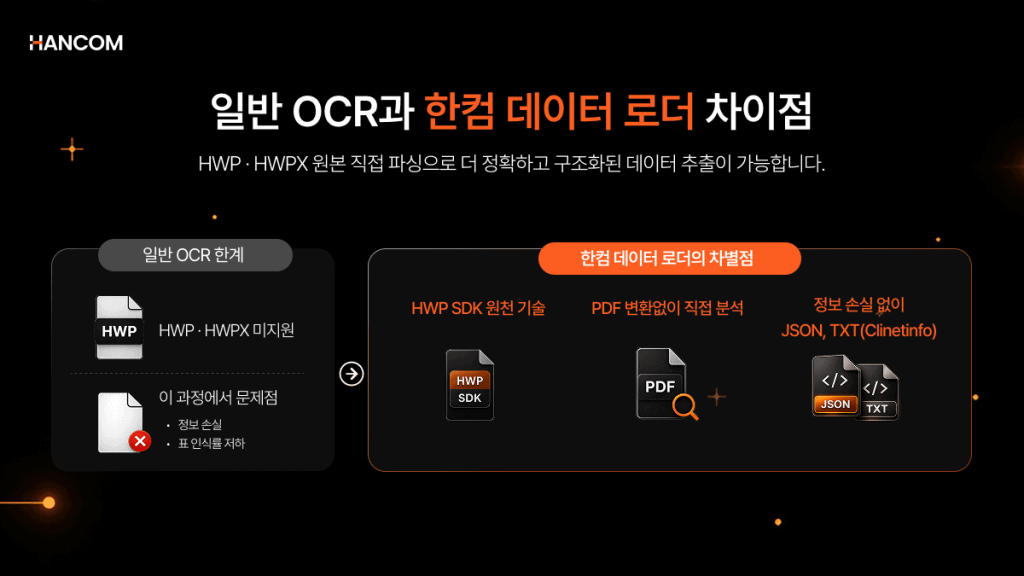
HWP and HWPX files are processed by parsing the original file directly, preserving table structure, footnotes, and metadata without requiring conversion to PDF. This approach directly addresses the problem identified earlier: ‘HWP is a binary format that is difficult to read with general tools.’
Converting to PDF before extraction often causes structural information such as tables and footnotes to be lost in the process. Direct parsing of the original minimizes information loss and preserves it intact. HWP and HWPX documents also provide hierarchical structure information based on paragraphs, extracting how titles, body text, and tables are organized in relation to one another. Given that a significant portion of public and financial documents are stored in this format, which is optimized for the domestic work environment, the ability to handle originals directly plays a key role in transforming previously inaccessible materials into usable data.
Can Tables with Merged Cells and Multi-Level Headers Be Extracted Accurately?
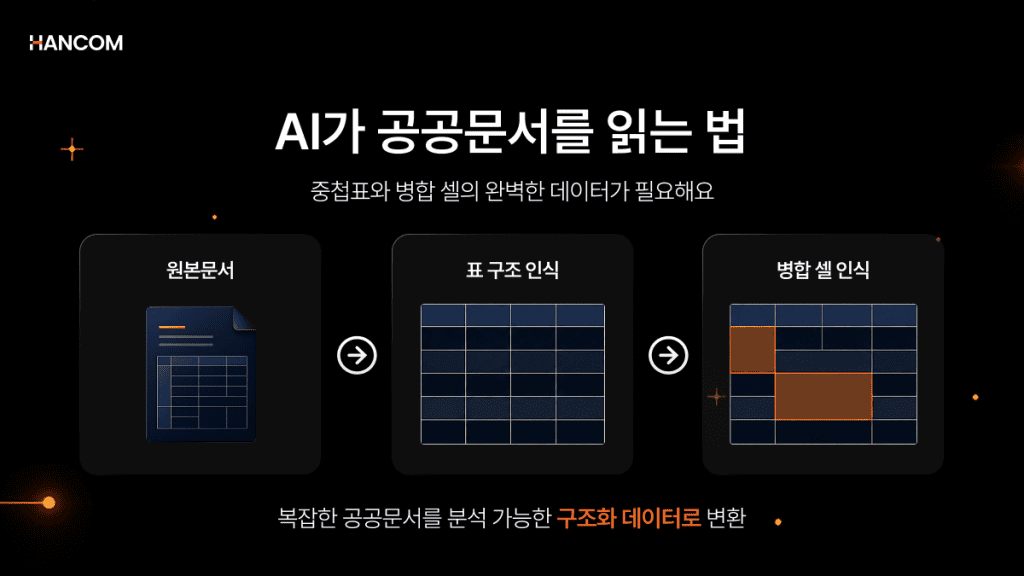
TSR technology identifies relationships between cells to restore the logical structure of borderless tables, merged cells, and even nested tables.
TSR is a technology that converts tables in images into logical coordinates or markup sequences. Because it first identifies how cells are connected before reading characters in sequence, it maintains the connection between headers and values even in tables with merged cells or multi-row headers. The restored tables are output in Markdown, JSON, or HTML at the cell, row, and column level, ready for immediate use without additional post-processing. This is especially important for public and financial documents where the table itself carries meaning.
In What Format Is Document Parsing Output Delivered?
Document parsing output is delivered in structured data formats such as JSON, HTML, and Clientinfo, depending on the usage environment and input format.
| Usage Environment | Input Format | Output Format |
| Studio | PDF / PDF AI | JSON, HTML, Viewer |
| Studio | HWP, HWPX | JSON, Viewer |
| Solution | PDF AI, HWP, HWPX | JSON, Clientinfo |
| Solution | OOXML | Clientinfo |
| API SaaS | PDF, HWP, HWPX | JSON |
The key point is that unstructured data is output in structured formats such as JSON. Structure-preserved JSON can be used directly for RAG integration, AI training data acquisition, and search indexing, significantly reducing the work required in subsequent stages.
Types of Document Parsing Solutions and Selection Criteria
When choosing a document parsing solution, compare based on table and structure preservation capability, supported input format range, and support for secure environments such as closed networks.
Criteria for Selecting Unstructured Data Preprocessing Tools for RAG
Table and structure preservation capability, supported input format range, and secure environment support—these three are the core criteria for selecting a RAG document preprocessing tool.
Because structural damage (formatting noise) causes cascading performance degradation in both the retrieval and generation stages of RAG, structure preservation capability is the first criterion. Additionally, the deep learning survey for OCR and document understanding explains that end-to-end systems integrating document layout analysis, text recognition, and information extraction are becoming increasingly important in the field of document understanding. In summary, it is advisable to confirm the following three points:
✅ Table and Structure Preservation Capability
Does it extract tables with merged cells and multi-level headers while preserving relationships?
✅ Supported Input Format Range
Does it handle the document formats you actually possess, such as HWP, HWPX, PDF, and OOXML?
✅ Secure Environment Support
Can it be operated in on-premises or closed-network environments?
💡 Looking for a solution that meets all three criteria—from table and structure preservation to secure environment support?
👉 Learn more about Hancom Data Loader
Comparison of Document AI Solutions by Closed-Network Environment Support
Document AI solutions are divided into cloud-based methods that transmit documents to external servers and on-premises methods that install on internal servers so documents do not leave the organization.
| Criteria | On-Premise | SaaS API (Cloud) |
| Installation Location | Customer’s internal server | External cloud integration |
| External Data Transmission | None | Transmitted to external server |
| Billing | Build-out model | Per-page billing |
| Suitable Environment | Public institutions, finance, and other closed networks | Rapid adoption and pilot projects |
Hancom Data Loader offers both methods. On-premises installs and operates directly on the customer’s internal server, ensuring documents do not leave the organization, making it suitable for high-security closed networks such as public institutions and finance. SaaS API integrates immediately without a separate server and bills per page, making it ideal for starting quickly without initial investment or for pilot use before on-premises deployment.
Benefits of Automating Document Parsing
Automating document parsing enables immediate use of structured data with preserved tables, hierarchies, and metadata for RAG and AI training, significantly reducing post-extraction work. However, for documents where automatic extraction alone cannot ensure accuracy, Data Loader Studio (an extended solution) allows users to review results directly and make necessary corrections.
Data Loader Studio assists in review by displaying preprocessed extraction results side by side with the original document. Users can directly verify and correct hierarchy, category, and reading order to refine document structure and semantic relationships to fit business purposes. Semantic-based tagging and labeling can supplement extraction criteria tailored to customer formats, refining data to a quality suitable for training and search.
💡 Want to see firsthand how your HWP and PDF documents are structured?
👉 Inquire about Hancom Data Loader adoption
Frequently Asked Questions (FAQ) About Unstructured Data Parsing
What Is the Biggest Difference Between Unstructured Data and Structured Data?
The presence or absence of a schema (predefined structure) is the key difference. Structured data is stored with a row-and-column schema, while unstructured data is stored in its original form without a schema.
Can HWP Files Be Parsed with AI Document Parsing?
Yes. Hancom Data Loader parses HWP and HWPX originals directly, extracting tables, footnotes, and metadata without requiring PDF conversion.
Are Documents with Nested Tables or Merged Cells Extracted Accurately?
TSR technology handles this. It identifies relationships between cells to restore the logical structure of nested tables, merged cells, and borderless tables.
Can Document Parsing Solutions Be Used in Closed-Network Environments?
Yes, through on-premises deployment. Installation on internal servers ensures documents are not transmitted externally, making it suitable for public and financial closed networks.
Can Document Parsing Results Be Used Directly in RAG Systems?
Yes. Output in structured formats such as JSON enables direct integration into RAG pipelines. Preserved structure reduces the post-processing burden in retrieval and generation stages.

Unstructured Data Parsing: Ensuring RAG Quality with AI Document Parsing
The challenges of unstructured data parsing can be summarized in three main points: parsing is difficult due to the absence of a predefined structure; corrupted extraction results flow through the retrieval and generation stages of RAG, degrading quality; and therefore, AI document parsing that preserves structure becomes the key to quality.
🖥️Hancom Data Loader
Hancom Data Loader is a document parsing solution that parses HWP and HWPX originals directly, restores complex tables with TSR, and handles closed-network documents in on-premises environments. You can see firsthand in the live demo how documents that were previously difficult to digitize are transformed into structured data ready for immediate use in RAG.
👉 Experience the Hancom Data Loader live demo
👉 Inquire About Hancom Data Loader
References
- IBM, “Structured vs. Unstructured Data: What’s the Difference?”
- IBM, “What Is Unstructured Data?”
- arXiv, “Robust Table Detection and Structure Recognition from Heterogeneous Document Images” (RobusTabNet), 2022
- arXiv, “Multi-Cell Decoder and Mutual Learning for Table Structure and Character Recognition,” 2024
- arXiv, “TABLET: Table Structure Recognition using Encoder-only Transformers,” 2025
- arXiv, “OCR Hinders RAG: Evaluating the Cascading Impact of OCR on Retrieval-Augmented Generation” (OHRBench), 2025
- arXiv, “Evaluating and Enhancing Retrieval-Augmented Generation with Hierarchical Chunking” (HiChunk), 2025
- arXiv, “Document Parsing Unveiled: Techniques, Challenges, and Prospects for Structured Information Extraction,” 2024
- arXiv, “Document Intelligence in the Era of Large Language Models: A Survey,” 2025
- arXiv, “A Survey of Deep Learning Approaches for OCR and Document Understanding,” 2020
- arXiv, “OCR Hinders RAG: Evaluating the Cascading Impact of OCR on Retrieval-Augmented Generation” (OHRBench), 2024