Public Institution HWP Parsing Solution Adoption Checklist | GS Certification, Network Separation, and On-Premises Criteria

A document parsing program for public institutions serves as the first step in transforming decades of accumulated HWP and HWPX documents into data that AI can immediately use. In practice, however, integrating a parser often results in damaged tables and lost footnotes. To avoid post-adoption regret, this checklist covers what to confirm upfront—from HWP and HWPX processing methods to GS certification.
Why AI Cannot Properly Read HWP and HWPX Documents in Public Institutions
AI struggles to read public-institution documents for two main reasons: the proprietary format structure of HWP and HWPX, and restrictions on cloud AI use imposed by network separation environments.
First, the most prevalent formats—HWP and HWPX—store content in proprietary structures rather than plain text, making it difficult for machines to directly extract elements such as tables, footnotes, and paragraph hierarchies. Second, most institutions operate under network separation policies, which prevent the use of cloud-based document AI services that require sending files to external servers. When general OCR (Optical Character Recognition) is forced to extract text, tables and footnotes are often lost together, compounding the problem. As a result, the structural information inherent in the original document is degraded across multiple stages.
Structural Limitations of the HWP and HWPX Formats
HWP and HWPX are not plain-text formats but proprietary structures, making it difficult for machines to directly extract structural information such as tables, footnotes, and paragraph hierarchies.
According to the HWP format structure analysis on Hancom’s Tech Blog, HWP is based on CFB (Compound File Binary), a format developed by Microsoft. This structure stores multiple data streams within a single file, much like folders, with document signatures and version information, common attributes such as fonts and paragraph styles, and the actual body text each stored in separate locations. Each data stream is tagged with metadata indicating its type and size. While users can open and read the document directly in the Hangeul word processor, machines must first parse this structure to access the content.
HWPX presents a different scenario. Built on open XML standards, its data is structured in a way that is relatively easier to interpret. In contrast, HWP is a binary format designed to be opened and edited only by specific software, making it significantly more challenging to parse. Both formats are optimized for domestic work environments, but these structural differences impose constraints when AI attempts to process them directly.

Network Separation Environments: Constraints on Document Parsing Solution Adoption
Most public institutions operate under network separation policies. Cloud-based document AI solutions require transmitting documents to external servers, which conflicts with security policies and limits adoption.
In practice, major international cloud document AI services support a variety of formats including images, PDFs, and OOXML, but HWP and HWPX—which account for a substantial portion of domestic public documents—are typically absent from their supported file lists.
The issue extends beyond file format support. Cloud APIs are predicated on sending documents to external servers for analysis, a structure that becomes a disqualifying factor in public-sector and financial closed networks where document leakage constitutes a security incident. Demand is strong for solutions that process sensitive data without transmitting it outside the internal network, and there is a clear trend toward on-premises deployment that keeps data under local control. In public institutions, where processing occurs is as critical a prerequisite for adoption as how well the solution reads documents.
Data Loss When Extracting HWP and HWPX Tables and Footnotes with General OCR
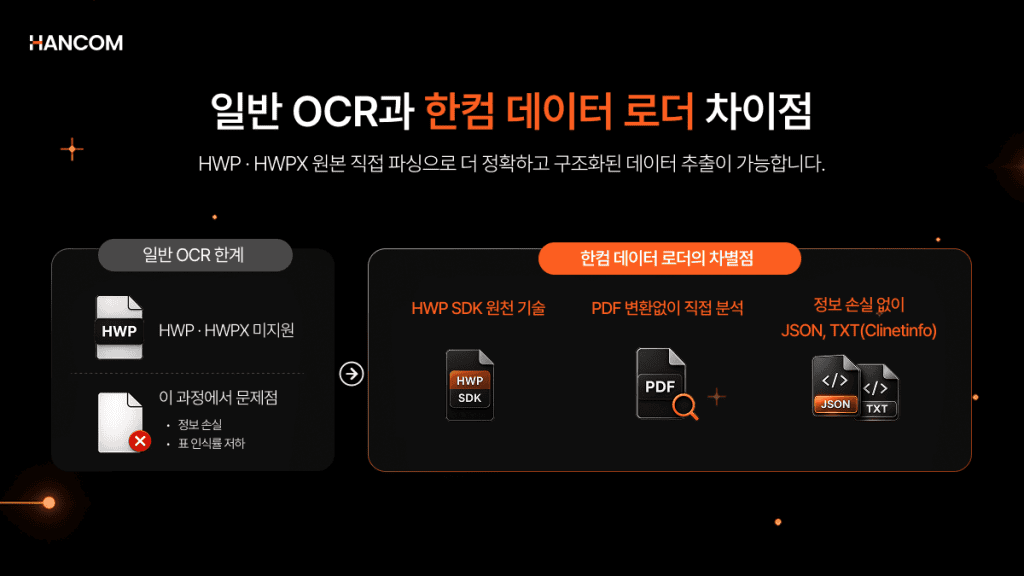
When HWP and HWPX files are converted to PDF and then processed with OCR, tables are rendered as images and become unrecognizable, and layout elements such as footnotes and indentation are also lost.
General OCR does not directly support HWP and HWPX, requiring an intermediate conversion to PDF. It is precisely during this conversion step that the structural information present in the original is lost. Tables containing merged cells, in particular, may be converted entirely into images, preventing the recognition of internal text.
A single misrecognized table cell propagates that error through subsequent search and answer stages. Research on OCR and RAG (Retrieval-Augmented Generation) analyzed this cascading phenomenon across seven real-world business domains, categorizing OCR errors into those that distort meaning and those that damage formatting. The findings were clear.
Among currently available OCR solutions, none can reliably produce a knowledge base suitable for RAG. Once errors are introduced at the extraction stage, no amount of downstream correction can restore the original quality.

What Criteria Should Guide the Selection of HWP and HWPX Parsing Solutions for Public Institutions?
The core criteria for evaluating document parsing solutions for public institutions are threefold: native HWP and HWPX processing without conversion, internal network security maintenance, and output formats compatible with AI integration.
It is advisable to compare document parsing solutions based on these three criteria: whether they process HWP and HWPX originals directly without conversion, whether document data remains within the internal network, and whether results are provided in formats that AI can immediately use.
How Document Parsing Processing Methods Affect Structure Preservation
The degree to which structural information such as tables and footnotes is preserved differs entirely depending on whether the method involves PDF conversion or direct analysis of the original file.
Processing after PDF conversion turns tables into images and loses formatting information, whereas parsing the original directly preserves table structure, footnotes, and metadata intact. The difference becomes especially pronounced with complex tables—such as those with merged cells or multi-level headers—because the difficulty of TSR (Table Structure Recognition) increases accordingly.
Difference in Structural Information Preservation Between PDF Conversion and Native Direct Parsing
| Category | PDF Conversion Method | Direct Original Parsing |
| Table Structure | Converted to image; cell recognition impossible | Preserved at row, column, and merged-cell level |
| Footnotes and indentation | Lost during conversion | Layout elements retained |
| Metadata | Mostly lost | Document properties extracted together |
| RAG integration suitability | Low (requires reprocessing) | High (structured data output) |
Why Security Environment Determines Document Parsing Solution Selection
Even with identical functionality, the range of solutions that public institutions can deploy changes completely depending on whether data is transmitted externally or processed solely within the internal network. Open-source solutions offer the advantage of being free but often lack support for HWP and HWPX. Cloud APIs enable rapid deployment but require sending documents externally, making them difficult to use in closed networks. On-premises deployment, by contrast, can be installed directly on internal servers to meet security requirements, though it does require initial setup.
This is not a concern unique to specific agencies. Research on on-premises RAG design notes that strict data protection regulations prevent many organizations from using cloud services, necessitating on-premises deployment, and highlights the problem that most existing reference architectures are cloud-centric, leaving a gap in comprehensive frameworks for on-premises environments.
Comparison of Open-Source, Cloud API, and On-Premises Approaches for Public Institution Suitability
| Category | Open Source | Cloud API | On-Premise |
| Cost | Free | Usage-based billing | Setup cost |
| HWP and HWPX support | Limited or unsupported | Generally unsupported | Supported |
| External transmission | Depends on environment | Required | None |
| Network separation suitability | Low | Impossible | Suitable |
| Setup complexity | Medium | Low | Initial setup required |
The Importance of Document Parsing Output Formats for RAG and AI Integration
In document parsing for AI integration, whether the extraction result is flat text or a structured format such as JSON or HTML significantly affects the difficulty of connecting to downstream RAG pipelines.
Flat text without structural information is difficult to segment into meaningful units, whereas structured formats such as JSON or HTML can be connected directly to the next stage. The hierarchical information extracted by the document parsing tool then serves as the basis for segmenting documents into semantic units in the subsequent stage handled by Hancom’s RAG solution, Hancompedia.
As research on the impact of OCR on RAG demonstrates, the quality of the extraction stage sets the upper bound for downstream search accuracy. If structure is lost in the initial stage, even the best models applied later will face inherent limitations, making output format a choice that determines the quality of the entire pipeline.
Public Institution Document Parsing Solution Adoption Checklist
Document Parsing Solution Adoption Checklist at a Glance
When adopting a document parsing solution in a public institution, confirm five key points upfront: HWP and HWPX processing method, structure preservation, security environment, and output format.
1. Does it process HWP and HWPX originals directly without conversion?
Processing the original directly is necessary to extract tables and footnotes without loss.
2. Are structured and unstructured document processing methods separated or used in parallel?
Documents with consistent formatting are processed using rule-based methods, while documents containing mixed images and tables are processed using AI-based methods to extract data.
3. Are tables, footnotes, and metadata preserved?
The more complex the table, the more structure preservation determines quality.
4. Is on-premises deployment possible?
In network separation environments, internal installation without external transmission is a prerequisite.
5. Does it provide output formats (JSON, HTML, Clientinfo) that connect directly to RAG and AI pipelines?
Only structured output can be connected without reprocessing.
These five points are not a feature list for a specific product but items organized in response to the bottlenecks diagnosed earlier. Priorities may vary by institution, so review them with appropriate weighting for your situation.
Precautions Before Adopting a Public Institution HWP Parsing Solution
In addition to the five points above, public institutions must also confirm whether the solution meets public procurement requirements such as GS certification. GS certification is a nationally recognized software quality system administered by the TTA (Telecommunications Technology Association) under the Software Industry Promotion Act. Products that pass multifaceted quality evaluation based on international standards receive a quality certification mark.
This certification is particularly important in public procurement because of its practical benefits in B2G (business-to-government) transactions. GS-certified products can be designated as priority purchase items (technology development products) for public institutions and receive support for registration on procurement platforms and negotiated contracts, providing a competitive advantage in the procurement process. In practice, as seen in the case of Hancom’s Hangeul and OCR SDK Britihyang version obtaining GS certification Grade 1, products targeting the public and procurement markets are increasingly securing this certification.
✅ In addition, it is recommended that you directly test accuracy using actual document samples from your holdings before adoption.
Because document formats and table structures vary by institution, results confirmed with your own documents provide the most accurate basis for judgment.
Hancom Data Loader: A Solution That Meets Public Institution Document Parsing Criteria
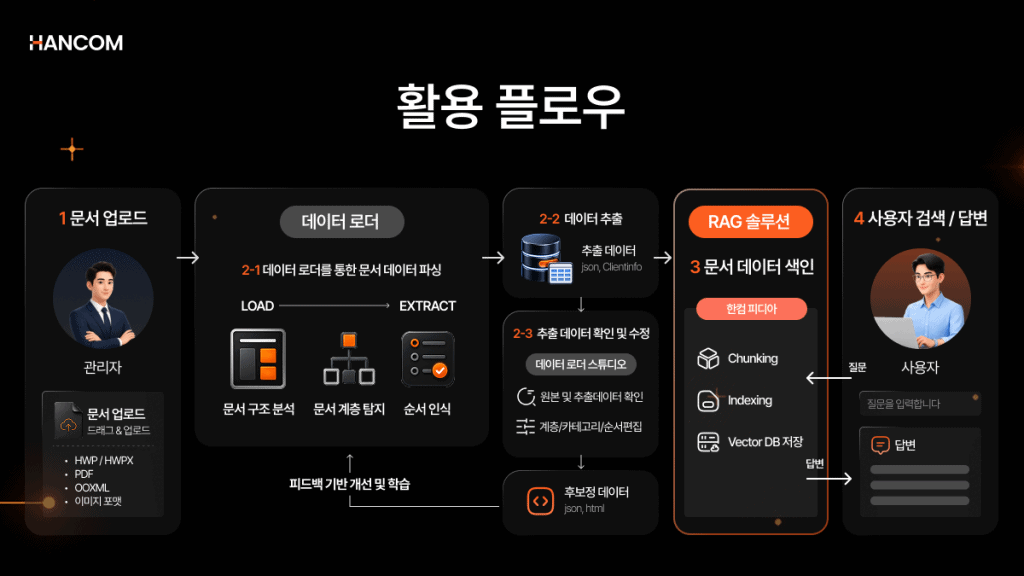
Hancom Data Loader is a document parsing solution that converts HWP, HWPX, PDF, and OOXML into structured data. The following sections examine how it actually meets the three core criteria and checklist items outlined earlier, in the order of native processing, security environment, and output format.
Native Direct Parsing of HWP and HWPX at the Core
Hancom Data Loader parses HWP documents by analyzing the original directly without conversion, preserving table structure, footnotes, and metadata intact. The absence of a PDF conversion step eliminates structural loss at the source. This approach directly satisfies checklist item 1: native processing.
This capability is grounded in Hancom’s long experience handling the HWP format. The Python HWP parsing example on Hancom’s Tech Blog shows how to extract document common information, body text, and embedded data from the CFB-based structure described earlier. Direct analysis of the original structure is essential to minimize information loss during extraction.
On-Premises and Closed Network Support Architecture
Hancom Data Loader supports document parsing in an on-premises deployment model, allowing installation on the customer’s internal servers and operation in closed network environments where documents do not leave the premises. Document data is not transmitted outside the internal network, making it suitable for environments with strict security requirements such as public-sector and financial institutions. Documents with consistent formatting can be processed quickly using rule-based models, while unstructured documents containing mixed images and tables can be processed precisely using DLA (Document Layout Analysis)-based methods, with the option to select or combine approaches. This architecture directly addresses checklist item 4: on-premises deployment.
Actual public-sector adoption confirms this capability. In the case where Hancom supplied AI solutions for the Ministry of the Interior and Safety’s ‘Government-Wide AI Common Infrastructure’ project, Hancom Data Loader served as the ‘AI training data extraction solution,’ precisely structuring public documents. The role of connecting this extracted and parsed data to subsequent search and question-answering functions is handled by Hancompedia, Hancom’s RAG solution supplied alongside, with the two products’ roles clearly delineated.
Structured Output for RAG Pipeline Integration
Hancom Data Loader outputs document parsing results in structured formats such as JSON, HTML, and Clientinfo, enabling direct connection to RAG pipelines without additional processing. Output formats vary slightly depending on the usage environment and input format.
- Studio (extended solution): PDF outputs JSON and HTML; HWP and HWPX output JSON
- Solution: JSON and Clientinfo / API SaaS: JSON
The structured data extracted in this way includes the document’s hierarchical information, which then serves as the basis for Hancompedia to segment documents into semantic units in the subsequent stage.
For reference, Hancom’s acquisition of GS Grade 1 certification for three AI products (Hancom Assistant, Hancompedia, and Hancom Data Loader) includes Hancom Data Loader, connecting to the procurement requirements noted earlier. In the so-called ‘datafication’ strategy of transforming accumulated public documents into assets for AI learning, this structured output serves as the practical foundation.
Public Institution Document Parsing Solution: Frequently Asked Questions (FAQ)
What is the most accurate method for extracting table data from HWP and HWPX files?
Converting to PDF and applying OCR results in significant loss because tables are rendered as images. The most accurate method is to parse HWP and HWPX originals directly without conversion, preserving table structure intact during extraction. Research findings that OCR-stage errors propagate to subsequent stages further support the necessity of native direct parsing.
Can document AI solutions be used in closed network environments?
Cloud APIs require transmitting documents externally, making them difficult to apply in closed network environments. However, on-premises deployment, which installs on internal servers, can operate without external transmission. This approach allows document AI adoption while complying with security policies, as data does not leave the institution.
Why is GS certification important in public procurement?
GS certification is a nationally recognized quality system under the Software Industry Promotion Act. Certified products can be designated as priority purchase items for public institutions and receive support for procurement registration and negotiated contracts.
Does Hancom Data Loader also parse OOXML documents natively?
OOXML documents are processed by extracting text directly from the original file without separate conversion. The processing method differs from that used for HWP, HWPX, and PDF, and OOXML is not included in the scope of DLA-based structure parsing. Output formats also differ, so it is advisable to review in advance whether the solution is suitable for the document formats primarily handled in your project.
Public Institution Document Parsing: When Adoption Criteria Must Be Reestablished
Conditions for Public Institution Document Parsing Solutions Confirmed by Checklist
The content covered so far can be summarized in three points.
First, whether HWP and HWPX originals are processed directly without conversion determines the preservation of structures such as tables and footnotes.
Second, in network separation environments, on-premises deployment that prevents data from leaving the premises is essential.
Third, the success of RAG integration is already determined by the output format of the extraction results.
Taken together, these conditions reveal that document parsing is not merely a process of extracting text but the foundation of AI document automation for public institutions—the beginning of datafication, transforming accumulated public documents into assets that AI can use.
Hancom Data Loader is a document parsing solution that converts HWP, HWPX, PDF, and OOXML into structured data. The extracted data can be linked with Hancompedia, Hancom’s RAG solution, enabling a unified Hancom stack from document collection through search and answer generation. Start the first step in transforming public documents into trusted AI data with Hancom Data Loader.
👉 Experience the Hancom Data Loader Live Demo
👉 Inquire About Hancom Data Loader
References
- arXiv, Junyuan Zhang et al., “OCR Hinders RAG: Evaluating the Cascading Impact of OCR on Retrieval-Augmented Generation”, 2024
- arXiv, Arun S. Maiya, “OnPrem.LLM: A Privacy-Conscious Document Intelligence Toolkit”, 2025
- arXiv, Chixiang Ma et al., “Robust Table Detection and Structure Recognition from Heterogeneous Document Images”, 2022
- arXiv, Nicolas Weeger et al., “AI Engineering Blueprint for On-Premises Retrieval-Augmented Generation Systems”, 2026
- Hancom Tech Blog, “HWP Document File Format: A Look at the HWP Format Structure”
- Hancom Tech Blog, “Parsing the HWP Format with Python (1)”
- Google Cloud, “Document AI — Supported Files”
- Amazon Web Services, “Amazon Textract — Input Documents”
- Hancom, “Hancom Supplies AI Solutions to the Ministry of the Interior and Safety’s ‘Pan-Government AI Common Infrastructure Project’”, 2025
- HelloT, “Hancom’s Three AI Products Earn GS Grade 1, ‘Proving Domestic AI Capabilities’”, 2025.01.16
- IT Daily, “[AI Solution Conference] Hancom: ‘Turn Accumulated Public Documents into AI Assets… The Key Is Datafication’”, 2026.05.28