Document Parser Getting Started Guide – A Comprehensive Overview of Hancom Data Loader’s Direct HWP/HWPX Parsing and Supported Formats

While corporate documents are vast, transforming the information within them into a format that AI can readily utilize is more complex than it seems. Simply extracting text misses too much information, such as PDFs containing images, tables full of merged cells, and heading-body structures distinguished by indentation.
Without document digitalization, it is difficult to fully begin building RAG systems, securing LLM training data, or developing agents. This guide provides a comprehensive summary of Hancom Data Loader’s supported formats, core features, and deployment methods.
Document Data Extraction: Why Can’t It Be Fed Directly into AI?
An increasing number of companies are looking to introduce generative AI into their operations, but many stall at the stage of utilizing internal documents for AI. The reason is usually the same: the process of converting documents into an AI-readable format—the document data extraction stage—is more complex than expected.

Why Unstructured Data Processing Is Complex – Different Preprocessing Methods for Each Format
The fundamental difficulty of unstructured data processing lies in the fact that completely different parsing strategies are required for each format. HWP and HWPX internal structures cannot be accessed without a dedicated parser, and while text-based digital PDFs and scanned image PDFs may look the same, their processing methods are entirely different. Adding OOXML into the mix makes consistent processing through a single pipeline a significant challenge.
A more difficult issue is the structural complexity within documents. In documents with multi-column layouts, the reading order for humans may differ from the extraction order for machines, and indentations created by user error can distort the hierarchical structure.
In particular, the HWP and HWPX formats, which account for the majority of documents in Korean public and financial environments, are often impossible to process using overseas open-source tools.
Limitations of Document Text Extraction
In a RAG pipeline, document parsing quality determines the accuracy of the final AI response. Simply extracting document text can lead to the following issues:
- Tables: If merged cells or nested tables are extracted simply, row and column relationships are damaged, causing the AI to lose context.
- Images and Charts: Key information contained in sales graphs, organizational charts, and process diagrams is not properly reflected during the extraction process.
- Hierarchical Structure: If the distinction between title–subtitle–body hierarchy becomes unclear, chunking boundaries become inaccurate, and both embedding quality and search accuracy decline.
If parsing quality is insufficient, results across the entire process—chunking → embedding → retrieval → answering—also become inaccurate. Document digitalization is a common prerequisite for building RAG solutions and AX.
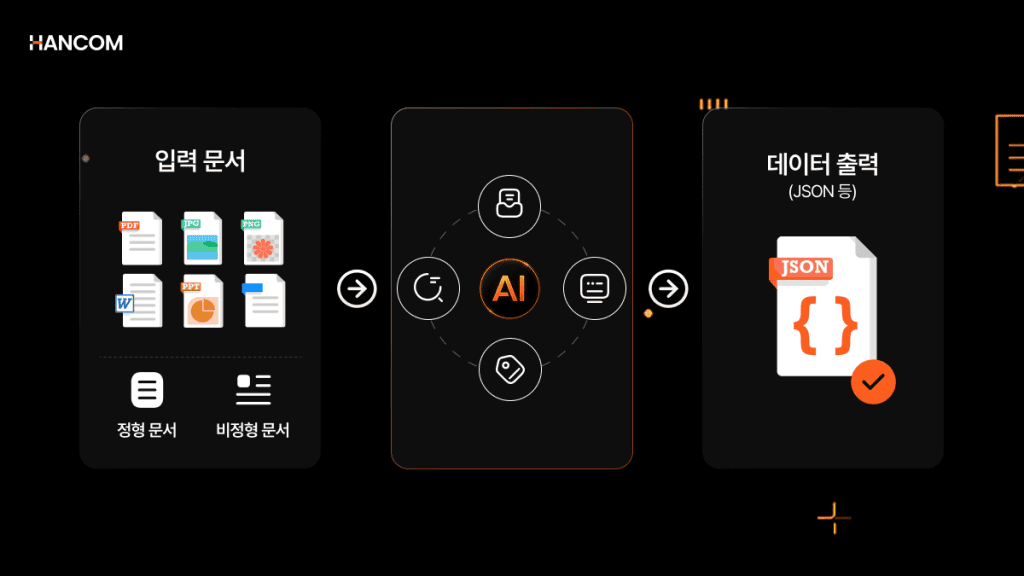
Hancom Data Loader – Document Parsing Solution for Document Digitalization
Hancom Data Loader is a document structure analysis solution that accurately separates and extracts documents down to semantic units, providing structured data along with agent-friendly metadata. Using a document structure-preserving extraction method rather than general OCR (Optical Character Recognition), it serves as a core preprocessing technology for RAG construction, creating more sophisticated and reliable document-based knowledge.
Document Data Output Formats and Extractable Formats – HWP, HWPX, PDF, OOXML
Hancom Data Loader supports all major document and image formats, including HWP, HWPX, PDF, OOXML, PNG, and JPG.
Comparison of Parsing Methods by Format for Hancom Data Loader
| Input Format | Processing Method | Key Features |
| HWP, HWPX | Direct Parsing of Original Binary | Preserves table structures, footnotes, and metadata; no PDF conversion required |
| Direct Original Extraction + OCR Integration | Includes scanned documents; structures via layout analysis | |
| OOXML | Text Extraction | Extracts text, tables, and images within Office documents |
| PNG, JPG, BMP | OCR-Based Recognition | Covers even scanned images |
Hancom Data Loader Output Formats
Extraction results are output in structured data formats such as JSON, HTML, and Clientinfo, depending on the usage environment (Studio/Solution) and input format. These can be utilized for purposes such as AI training, search indexing, and RAG.
| Usage Environment | Input Format | Output Format |
| Studio | JSON, HTML, Viewer | |
| Studio | HWP, HWPX | JSON, Viewer |
| Solution | PDF AI, HWP, HWPX | JSON, Clientinfo |
| Solution | OOXML, PDF | Clientinfo |
| API SaaS | PDF, HWP, HWPX | JSON |
🔗 Curious about more core features of Hancom Data Loader?
HWP/HWPX Data Parsing – Direct Extraction from Source Without PDF Conversion
Most parsing tools extract content after converting HWP/HWPX to PDF. In this process, tables are converted into images, making them unrecognizable, and formatting information such as footnotes, indentation, and bullets may also be lost.
In contrast, Hancom Data Loader directly analyzes original HWP/HWPX files to minimize structural distortion and information loss. It accurately reads complex bullet points and deeply indented lists, preserving the original structure and meaning. Even for indentations created by user error, the AI infers the level structure and automatically corrects it.
In addition, it provides level inference technology that automatically tags hierarchy levels by analyzing paragraph styles, indentations, and numbering systems. By recognizing the indentation-based hierarchical structures unique to Korean public documents, laws, and reports, it generates structured chunks and improves RAG search accuracy.
The Start of Workflow Automation: Core Document Data Extraction Technology, Semantix
Images, diagrams, and charts within documents are included alongside text, but in general extraction processes, they are often only recognized as individual objects.
Semantix addresses these limitations by first analyzing and interpreting complex PDF and image documents with AI, then extracting data that Hancom Data Loader can use. Based on various technologies such as OCR, table structure recognition (OCR, TSR (Table Structure Recognition, table structure recognition)), and image captioning (Image Captioning), it interprets visual elements together with context, enabling images and charts to be searched and used in the same way as text.
DLA
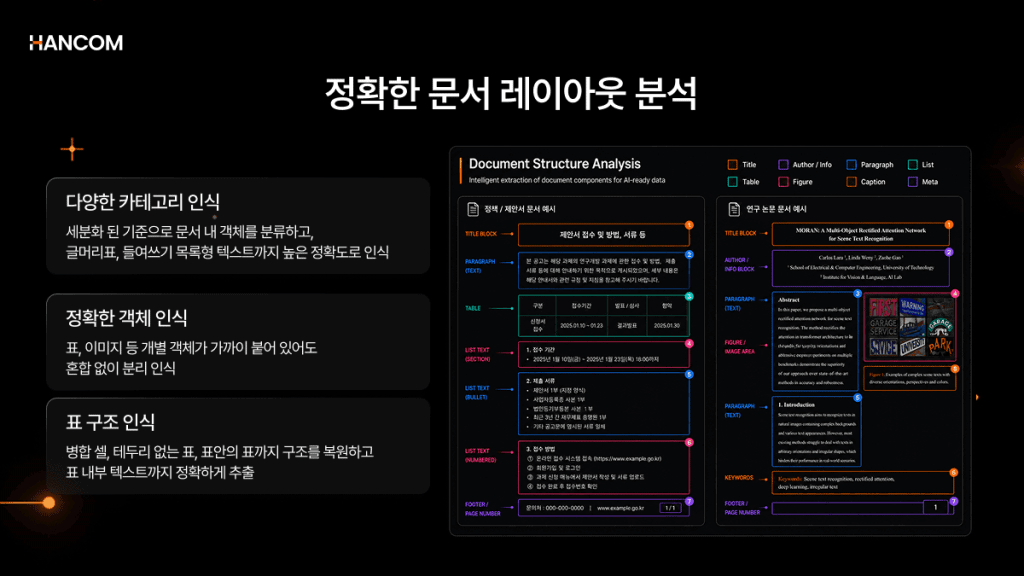
Document Layout Analysis (DLA) is a structural analysis technology that utilizes AI deep learning to distinguish various elements within a document—such as text, images, tables, and graphics—and accurately identify the position and relationship of each element. It classifies various objects based on granular criteria and recognizes bulleted and indented list-type text with high accuracy.
A particular strength is its ability to accurately distinguish and recognize elements positioned close together, such as tables and images, without mixing them. By automatically assigning the reading order with the document structure in mind—single-column, multi-column, translated versions, and more—it prevents incorrect data interpretation that is common in multi-column layouts. The extracted hierarchical information becomes the basis for semantic-unit chunking in the RAG pipeline, improving search accuracy as well.
Unstructured Data Processing – Data Separation with TSR
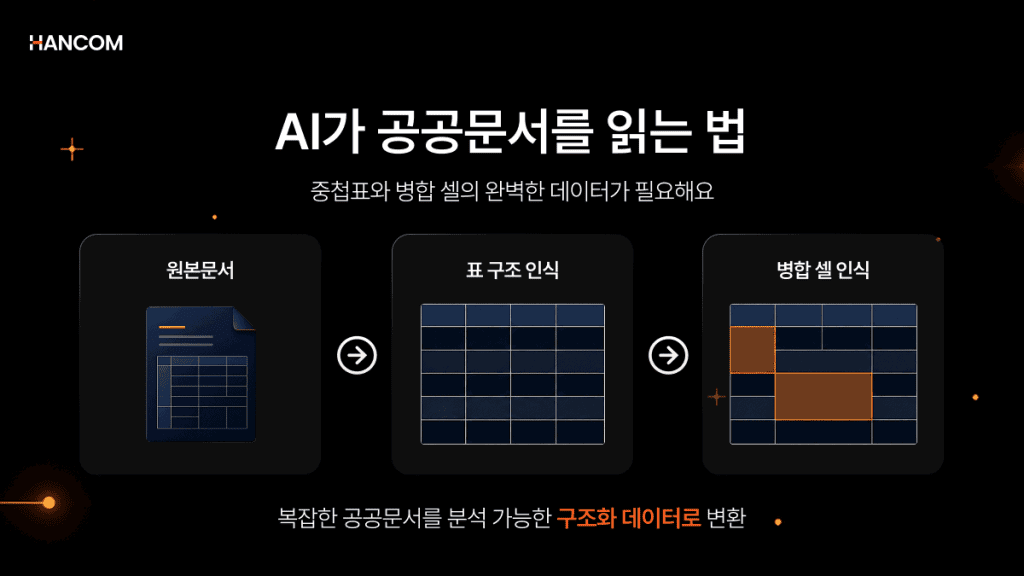
TSR is a technology that converts tables within images into computer-readable and processable data, while maintaining their row and column structure. It accurately restores the logical structure of tables by identifying cell relationships and fully supports borderless tables, merged cells, and nested tables. The converted data is output in Markdown, JSON, or HTML format at the cell, row, and column level, allowing for immediate use without additional post-processing.

Automatic Contextual Keyword Tagging for Images and Charts – Image Captioning
Image Captioning (Image Captioning) is a technology that understands the context and relationships of objects in an image and generates them in natural language. It understands the context of unstructured visual information and converts it into data without loss, and analyzes relationships between objects to generate accurate captions.
It supports labeling optimized for B2G and B2B work environments. It can be operated quickly and stably without the need for separate high-specification infrastructure.
Its range of applications is also diverse. It improves image search and matching accuracy in RAG-based Q, strengthens accessibility for the digitally disadvantaged through automatic generation of alternative text, and even enables the construction of automatic classification pipelines through image tagging and metadata assignment.
※ The Image Captioning feature is currently in the PoC stage, and the commercial release schedule will be announced later.
👉 Learn more about Hancom Data Loader technology
RAG Pipeline – From Document Upload to AI Response
Hancom Data Loader supports the document preprocessing stage of the RAG pipeline, from document collection to structured data extraction. When documents are uploaded, they are converted into AI-ready data without separate preprocessing.
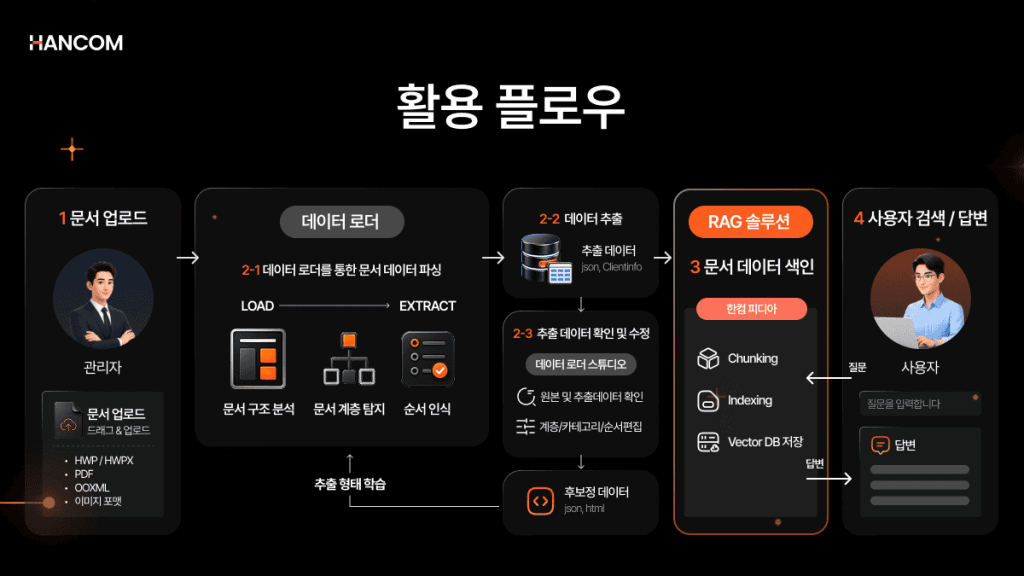
From Document Parsing to Structured Data Generation
When a document is input, it goes through the LOAD (document collection) → EXTRACT (document structure analysis, hierarchy detection, order recognition) stages to generate structured data. It is organized in a form that includes the context and structure of the document, rather than just simple text.
Review and Post-Correction of Extraction Results via Data Loader Studio
The extracted data can be reviewed side-by-side with the original document in Data Loader Studio (extended solution).
Users can directly review hierarchy, categories, reading order, and more, and post-edit what’s needed so the document structure and semantic relationships are refined to fit real business purposes. In addition, semantic-based tagging and labeling can supplement extraction criteria to match customer document templates, improving data quality to better suit training and search.
Hancom Pedia Integration – Integrated RAG Pipeline Construction
The refined data goes through the chunking → embedding → vector DB storage stages and connects directly to the RAG pipeline. By integrating directly with Hancom’s proprietary RAG solution Hancompedia, you can quickly build a document-based knowledge search system.
If you are considering implementing document parsing, you can directly upload HWP, HWPX, and PDF files to the Hancom Data Loader live demo to check the DLA and TSR results.
👉Go to Hancom Data Loader Live Demo
Comparing Document Parsing On-Premise and SaaS API – Choosing the Deployment Method That Fits Your Situation
Hancom Data Loader supports two deployment methods depending on the security environment and implementation purpose. On-premise is a method of installing and operating directly on the customer’s internal server, while the SaaS API method allows for immediate integration and use without separate installation.
On-Premise Document Parsing – A Closed Network Environment Where Documents Do Not Leave the Premises
Hancom Data Loader is designed to be installed and operated on the customer’s internal server, ensuring that document data is not transmitted externally. It can be operated even in closed network environments with limited internet access, making it suitable for environments with high security requirements, such as public and financial institutions.
Furthermore, you can choose between two extraction methods depending on the document type. Structured documents with consistent formats, such as official, legal, and medical documents, are processed quickly using a rule-based model based on a predefined schema. Unstructured documents mixed with drawings, tables, and images undergo precise structural analysis using an AI OCR-based layout analysis method. You can choose the method that fits your company’s situation or use them in combination.
SaaS API Method – Start Immediately Without Installation
The SaaS API method can be integrated and used immediately without building a separate server. Costs are incurred only for what is used through a per-page billing structure, allowing for rapid implementation without initial investment costs. It is also suitable for pilot testing before on-premise deployment.
Comparison of On-Premise and SaaS API Deployment Methods
| Comparison Item | On-Premise | SaaS API Method |
| Data Security | Contained within internal network; operable without external transmission | Processed via external API calls |
| Initial Cost | Server infrastructure construction required | Usable without initial investment |
| Billing Method | Solution implementation cost | Usage-based billing (per page) |
| Implementation Speed | 컨테이너 기반 설치 후 내부 환경에 맞게 구축·운용 | Can start quickly via API integration |
| Suitable Environment | Environments processing sensitive data, such as public institutions and large corporations | Pilot/small-scale testing, environments requiring rapid application |
Document-Based AX Starting with Hancom Data Loader
🖥️ Hancom Data Loader
Document digitalization is a common prerequisite for building RAG systems, securing LLM training data, and developing AI agents.
Hancom Data Loader uniquely supports HWP and HWPX in their original form without PDF conversion, and also processes various formats including PDF, OOXML, and images. It converts major document formats, including HWP, HWPX, and PDF, into structured data while preserving table, hierarchy, and image structures.
Even after parsing, it supports post-editing through Data Loader Studio, and through integration with Hancompedia, it can support document-based AI implementation, including building the RAG pipeline.
If you want to optimize your in-house AI development, you can find relevant information on the Hancom Data Loader website.
👉Go to Hancom Data Loader Live Demo
👉Inquire about Hancom Data Loader Implementation
References
- Hancom, “Hancom Data Loader”
- Hancom SDK, “Data Loader Service Page”
- inews24, “Hancom Unveils ‘Open Data Loader v2.0′”
- AI Times, “Global Launch of Hancom Data Loader”