Criteria for Selecting Public Institution Document Parsing Solutions | HWP Support and On-Premise Conditions Overview

Public institutions have accumulated decades of HWP and HWPX documents. The process of converting these vast assets into AI-utilizable data is what public institution document parsing entails. In practice, applying solutions often leads to issues such as misaligned tables or the complete omission of footnotes.
If documents are incorrectly read at the initial stage, that error propagates directly to the search and answer stages. Therefore, it is crucial to select a solution based on proper criteria from the outset. We have organized the criteria by what public institutions should verify to avoid failure when choosing a document parsing solution, from HWP/HWPX support to on-premise conditions.
Common Parsing Problems in Public Institution Documents
Why HWP Document Parsing is Difficult with General AI Tools
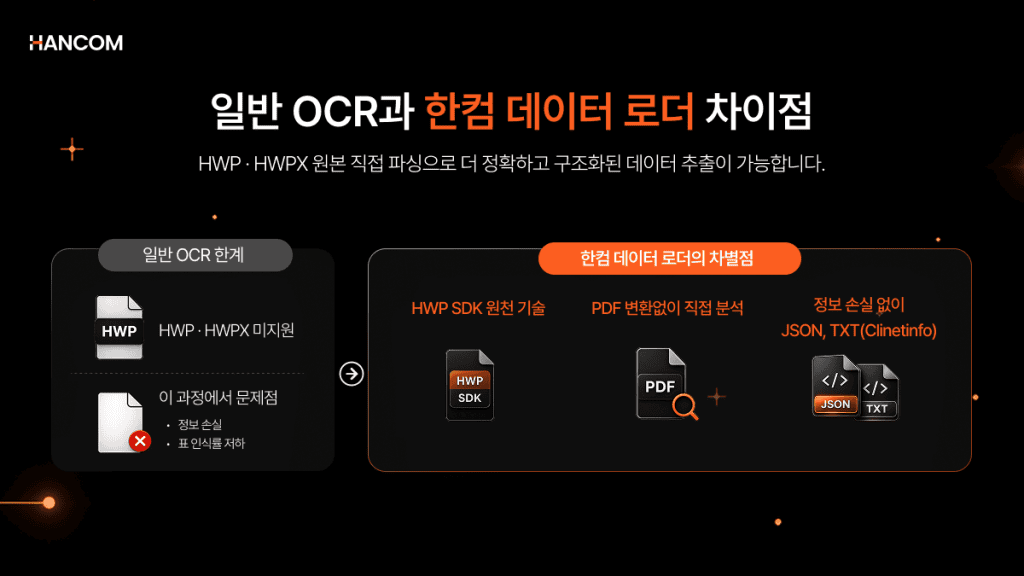
Most public institution documents are in HWP/HWPX format. General AI tools cannot directly read these formats and instead process them after converting them to PDF. It is precisely during this conversion step that structural information, such as tables or footnotes, can be lost.
HWP and HWPX are document formats optimized for the domestic business environment. Hancom documents accumulated over a long period in both public and private sectors represent important data assets for AI to learn from.
According to Hancom Tech Blog, Hancom has historically disclosed its file format specifications and distributed HWPX converters for free. However, just because a format is open does not mean that machines can immediately understand its internal structure.
There’s a reason why merely extracting text is insufficient. Research on document layouts (LayoutLM) points out that existing methods, by focusing solely on reading characters, miss crucial layout and formatting information necessary for a complete understanding of a document. If the relationships—such as which cell in a table belongs to which item, or which sentence a footnote is linked to—are lost, humans can grasp it at a glance, but AI will only understand half of the document.

Public Documents with Many Merged Cells and Multi-Column Headers: Limitations of Table Structure Recognition
Merged cells, multi-level headers, and tables without borders, which frequently appear in public documents, are often recognized with damaged structures when processed by conventional methods. This is because the difficulty of Table Structure Recognition (TSR), which restores the row and column relationships of tables, is exceptionally high.
Specifically, common points of misalignment in public documents are as follows:
- Merged Cells: Fails to recognize tables where multiple cells are combined as a single structure.
- Multi-column Layout: Reading order gets mixed up, causing items and values to mismatch.
- Borderless Tables: Not recognized as tables and processed as plain text.
- Result: Damaged data leads to reduced RAG search accuracy.
Detecting tables and recognizing their structure is a task so challenging that it is a separate field of research in deep learning.
A survey on table detection and structure recognition research also highlights this point. Ultimately, if even a part of a table is misread, that error propagates to subsequent search and answer stages. Therefore, the key lies in how completely the table structure can be preserved.
💡 You can see how easily damaged table structures like merged cells and multi-column headers are preserved in the Hancom Data Loader demo.
Criteria for Selecting Public Institution Document Parsing Solutions
There are four decisive criteria when selecting a document parsing solution for public institutions: whether it can directly read native HWP/HWPX files without conversion, whether documents remain within the internal network, whether it can process structured and unstructured documents together with a single solution, and whether it allows for prior verification without initial setup.
Support for Native HWP/HWPX Parsing
Solutions that directly process native binaries preserve the structure of the original file by dividing it into five stages, without an intermediate PDF conversion step. Here, ‘binary’ refers to the original file format saved by a program, not a document readable by the naked eye.
- Document – Receives the original document to be processed as is.
- Data Property Analysis – Identifies the nature of the document based on its constituent elements.
- Data and Information Extraction – Extracts text, tables, and hierarchical information.
- AI Augmentation – AI supplements areas where rule-based processing is insufficient.
- Data and Information Refinement – Refines the extracted results.
- Final Output Provision – Provides structured data as the final deliverable.
Handling the original file directly in this manner is essential to preserve table structures, footnotes, and metadata intact. According to research on document layout datasets (DocLayNet), accurately distinguishing document structures is treated as a separate challenge, requiring training on a large-scale dataset of 80,000 pages manually annotated by humans. This highlights why directly reading the original structure from the beginning is crucial.
Can Document AI Solutions Operate in On-Premise and Closed Network Environments?
If documents are not transmitted externally, a document AI solution can operate in a closed network environment using an on-premise approach. On-premise involves installing and operating the solution directly on the client’s internal servers, meaning document data does not leave the institution. This makes it suitable for public environments with high security requirements.
For institutions handling sensitive data like personal information, a structure where data does not leave the internal network is a prerequisite for adoption. Processing sensitive data without sending it externally is a challenge actually addressed in on-premise document AI research. This research primarily focuses on a completely internal execution method, with cloud integration available only if policies permit.
In fact, the Pan-government Hyperscale AI Common Platform Project promoted by the Ministry of Interior and Safety also aimed to enable government and local authorities to utilize generative AI without security concerns. This underscores that in the public sector, where data is processed is as critical as how well it is read when it comes to adoption.
Simultaneous Processing of Structured and Unstructured Documents: A Must-Have for Parsing Solutions
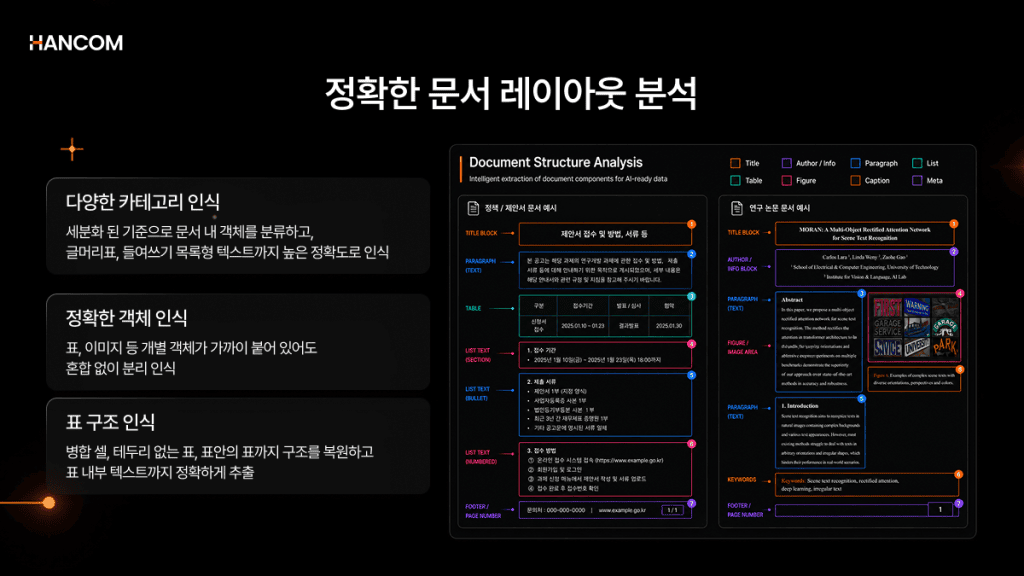
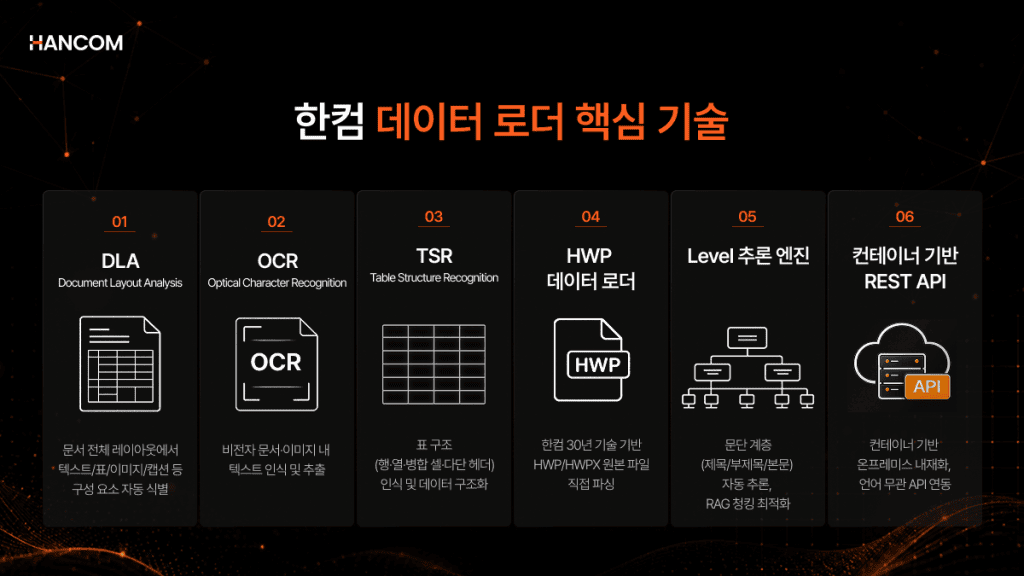
The ability to process both structured documents with fixed formats and unstructured documents containing scans or images together with a single solution is the criterion that prevents the need for two separate tools. Structured documents, such as official letters and laws with consistent formats, are processed quickly based on predefined rules, while unstructured documents mixed with images and tables are analyzed precisely using DLA (Document Layout Analysis).
Processing methods also vary by format. HWP/HWPX files are parsed directly to preserve tables and footnotes, while PDFs are extracted directly from the original, with OCR (Optical Character Recognition) linked for scanned documents. OOXML extracts text, and image files like PNG, JPG, and BMP recognize characters via OCR. By having a single solution select or combine these methods as appropriate, public institutions no longer need separate OCR solutions and structured document processing tools.
Accurately detecting components in complexly arranged documents remains an active area of research. Document Layout Analysis research (Hybrid DLA) discusses methods to improve the detection accuracy of document components like tables and figures using Transformer-based object detection technology. This demonstrates that properly reading unstructured documents is still not easy.
Public Institution Document Parsing Solution Implementation Costs and Scalability
For public institutions, which must consider budgets and verification procedures, a crucial criterion is whether there is a method to first verify the solution by paying only for usage, without initial server setup. The SaaS API approach allows for immediate integration without building a separate server, incurring costs only based on usage per page (document page).
This pay-per-page usage-based billing model is widely used in document AI APIs. Google Document AI also operates on a pay-as-you-go model, with costs determined by the number of pages processed, and no charges for failed requests. Since it eliminates the need for prior server setup, it is suitable for public institutions to verify performance with actual documents before committing to a large initial investment.
This approach is suitable for the initial stage of considering public institution document parsing automation. Without significant upfront investment, results can be verified with actual institutional documents, and then, as scale increases, it can be expanded to an on-premise setup. It is also suitable for pilot (verification) purposes as a pre-test before on-premise deployment.
💡 A solution chosen by the Ministry of Interior and Safety, Gyeonggi Provincial Office of Education, and the National Assembly, even in highly secure public environments.
👉 Learn more about Hancom Data Loader
3 Comparison Criteria for Public Institution Document Parsing Solutions
When comparing public institution document parsing solutions, rather than focusing on speed or accuracy metrics, it’s essential to first examine the structural differences in how documents are processed. The sophistication of the initial preprocessing ultimately determines the quality of the final search and answer results.
A Quick Guide to Evaluation Criteria for Public Sector Document Parsing Solutions
| Comparison criteria | Questions to Ask | Significance in an Institutional Environment |
| Presence of Conversion Step | Does it undergo PDF conversion, or does it directly parse the original (HWP/HWPX)? | Absence of conversion steps reduces loss of tables and footnotes. |
| Preservation of Tables/Footnotes | Are table structures, footnotes, and metadata preserved as is? | For complex tables, preservation significantly impacts quality. |
| On-Premise Support | Does it operate in a structure where documents do not leave the external network? | Essential for closed network environments. |
Particular attention should be paid to the first criterion in the table: the conversion step. This is because errors generated during the PDF conversion process are directly transferred to subsequent search and answer stages. Research on OCR and RAG integration confirms this phenomenon in various real-world business documents, where errors in the extraction stage lead to issues in subsequent search and generation, emphasizing that the quality of the initial stage sets the upper limit for the overall result. The second criterion, the preservation of tables and footnotes, also shows significant variation depending on the document type. Document parsing benchmark research stresses that tools performing well only on specific document types may show reduced accuracy with actual business documents, thus requiring evaluation with diverse document sets.
Ultimately, the focus of comparison is not which solution is faster, but whether its processing method aligns with the document formats and security environment of your organization.

Public Institution Document Parsing through Hancom Data Loader Adoption Cases
Gyeonggi Provincial Office of Education AI Digital Platform: Datafying Documents from 2,800+ Schools
In the Gyeonggi Provincial Office of Education’s AI Digital Platform construction project, Hancom Data Loader played a role in converting documents from over 2,800 schools into AI-trainable data. This was the first large-scale AI platform project for a provincial office of education nationwide, led by the LG CNS consortium.
According to Digital Daily, Hancom Data Loader converted over 40,000 guidance materials and more than 7,000 directives and laws from approximately 2,800 school websites into a format that AI can process.
Here, Data Loader’s role extends to the stage of extracting, parsing, and structuring documents. Hancom Pedia, the company’s RAG solution, then takes this converted data to provide Q based on school regulations and administrative guidelines, thus clearly delineating the roles of the two products.
Ministry of Interior and Safety, National Assembly: Document Parsing Adoption Spreading Across Public Institutions
Hancom Data Loader was also adopted for structuring public documents in the Ministry of Interior and Safety’s Pan-government Hyperscale AI Common Platform Project and the National Assembly’s Big Data Analysis Platform construction project. In the Ministry of Interior and Safety project, it precisely structured public documents as an AI learning data extraction solution.
For the National Assembly project, Hancom formed a consortium with Samsung SDS and was selected as the contractor for the 11.6 billion won project. Data Loader parses documents from the National Assembly Secretariat and National Assembly Library to build the foundation for a Vector DB, after which Hancom Pedia provides QA for legislative activities. As the scope expands across education, administration, and legislation, public document parsing is becoming a widely adopted approach among various institutions.
Starting Public Institution Document Parsing with Hancom Data Loader
🖥 What is Hancom Data Loader?
Hancom Data Loader is a document parsing solution that converts documents into AI-understandable data before an agent handles them. Hancom Data Loader is a document parsing solution that converts HWP, HWPX, PDF, and OOXML into structured data, with the key distinction being that it extracts while preserving the document’s structure, unlike general OCR.
Hancom has obtained GS Certification Grade 1 for its three AI products (Hancom Assistant, Hancom Pedia, and Hancom Data Loader), with Data Loader included among them.
Hancom Data Loader Technical Features
Hancom Data Loader meets the four selection criteria outlined earlier with the following technologies, where each criterion aligns with a specific technology.
✅ Direct Parsing of Native HWP/HWPX Binaries
Reduces loss of tables and footnotes by avoiding PDF conversion.
✅ Hybrid Support for On-Premise and SaaS API
Supports both internal installation for closed networks and usage-based verification.
✅ Simultaneous Processing of Structured and Unstructured Documents
Processes structured documents quickly with rule-based methods and unstructured documents precisely with AI-based methods.
✅ Obtained GS (Good Software) Certification Grade 1
The first point directly corresponds to the HWP/HWPX native parsing criterion, the second to the on-premise and implementation cost criteria, and the third to the simultaneous structured/unstructured processing criterion. By organizing the criteria and then comparing them with the features, it becomes much easier to determine if the solution is suitable for an institutional environment.
💡 If you’re curious about the best implementation method for your environment (on-premise/SaaS API), consult with a representative.
👉 Consult on Hancom Data Loader Implementation
Public Institution Document Parsing Solution Frequently Asked Questions (FAQ)
Does it support HWP files?
HWP and HWPX files are parsed directly without PDF conversion, extracting table structures and even footnotes. Handling these formats, optimized for the domestic business environment, without conversion is key to minimizing data loss.
Can it be applied in a closed network environment?
Yes, as it is an on-premise solution installed directly on internal servers, documents do not leave the network, allowing operation in closed network environments. It has actually been adopted this way in public sector projects.
What are the implementation costs?
The SaaS API model allows for verification without significant initial investment, as costs are incurred only based on page usage without initial server setup. On-premise costs are customized based on the client’s server environment and processing capacity (e.g., license, server units), with exact quotes provided through sales and consulting. The SaaS API is also suitable for pilot purposes before on-premise deployment.
Are there any public institution adoption cases?
It has been adopted in the Gyeonggi Provincial Office of Education’s AI Digital Platform, the Ministry of Interior and Safety’s Pan-government Hyperscale AI, and the National Assembly’s Big Data Analysis Platform, spanning education, administration, and legislative sectors. All are publicly reported cases.

Public Institution Document Parsing: Re-establishing Selection Criteria
Ultimately, the criteria for selecting a public institution document parsing solution narrow down to three points: whether it can directly read native HWP/HWPX files without conversion, whether documents remain within the internal network, and whether it can process structured and unstructured documents together with a single solution.
If it also offers a method for prior verification without initial setup, public institutions with strict budget and security procedures can smoothly begin implementation. Synthesizing these criteria reveals that document parsing is not merely about extracting text, but about transforming accumulated public documents into assets that AI can utilize.
Hancom Data Loader is a document parsing solution that directly reads native HWP/HWPX files without conversion, operates in closed network environments on-premise, and processes structured and unstructured documents together with a single solution.
Public institutions that have many HWP documents and hesitated to adopt due to security concerns can now review the option already verified by the Gyeonggi Provincial Office of Education, the Ministry of Interior and Safety, and the National Assembly.
👉 Learn more about Hancom Data Loader
👉 View more Hancom Official Blog content
References
- arXiv, Yiheng Xu et al., “LayoutLM: Pre-training of Text and Layout for Document Image Understanding”, 2020
- arXiv, Mahmoud Kasem et al., “Deep learning for table detection and structure recognition: A survey”, 2022
- arXiv, Birgit Pfitzmann et al., “DocLayNet: A Large Human-Annotated Dataset for Document-Layout Analysis”, 2022
- arXiv, Arun S. Maiya, “OnPrem.LLM: A Privacy-Conscious Document Intelligence Toolkit”, 2025
- arXiv, Tahira Shehzadi et al., “A Hybrid Approach for Document Layout Analysis in Document images”, 2024
- arXiv, Junyuan Zhang et al., “OCR Hinders RAG: Evaluating the Cascading Impact of OCR on Retrieval-Augmented Generation”, 2024
- arXiv, Linke Ouyang et al., “OmniDocBench: Benchmarking Diverse PDF Document Parsing with Comprehensive Annotations”, 2024
- Google Cloud, “Document AI pricing”
- Hancom Tech, “Korean documents for the AX era: Analysis of the open-source ecosystem status and activation strategies,” 2025
- Digital Daily, “Hancom Participates in Gyeonggi Provincial Office of Education AI Platform Construction Project”, 2025
- ZDNet Korea, “Hancom, Reborn as a Powerhouse in Public AI Projects, Also Takes on Ministry of Interior and Safety’s ‘Pan-government Hyperscale AI Project'”, 2025
- ZDNet Korea, “Hancom’s 3 AI Products Obtain GS Grade 1 Certification… ‘Proving Domestic Technology'”, 2025
- Chosun Biz, “Hancom and Samsung SDS Win National Assembly Big Data Platform Project, Beating KT and Megazone”, 2025